Workers on a Production Line: An Interview with A.M. Gittlitz
Disclosure: This article contains affiliate links, meaning The Fan Files will receive a small commission if you choose to purchase through any of the below links.
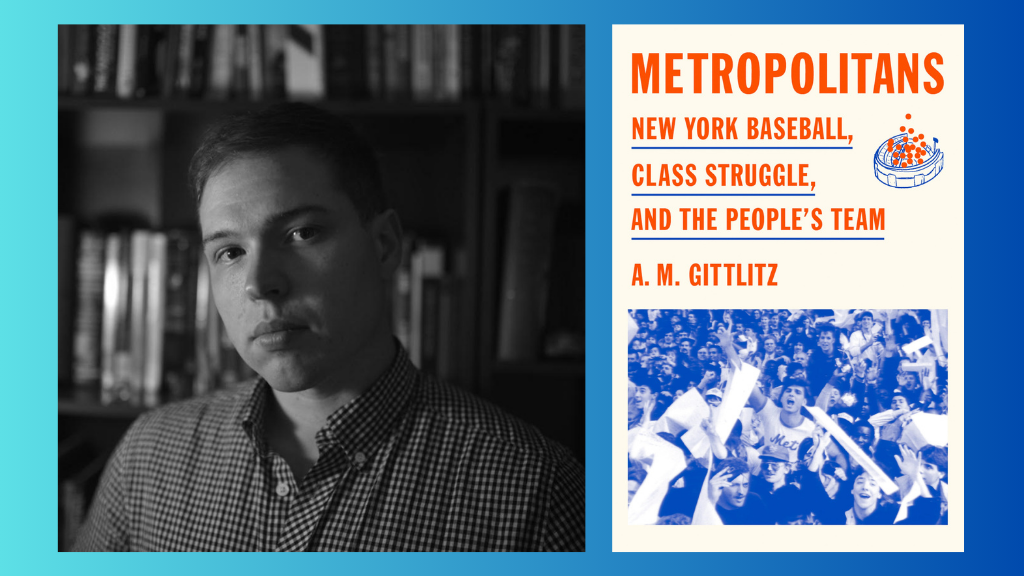
Metropolitans: New York Baseball, Class Struggle, and the People’s Team is not your typical baseball book (and I’ve read a lot of baseball books). Through its 496 pages, author A.M. Gittlitz weaves through decades of Mets history, pulling out fascinating nuggets and highlighting their connection to the politics and activism of the time.
Metropolitans makes an argument for looking at all baseball as a lens to understand class, but it also makes an argument that the Mets are unique in their relationship with politics and that the team has, for some reason, connected and reconnected with issues outside of the baseball stadium for years, solidifying their identity as “the people’s team.”
In the following conversation, Gittlitz chats his relationship with the Mets, his research process, and the origins of this project.
Tell me about your relationship with the Mets
As Mets fans like to say, since 1962, “I've been a Mets fan my whole life.” My dad was a Mets fan. In fact, I was born just a little bit over nine months after the '86 World Series. Probably not a coincidence. I think the first time I went to a game was in 1994, before the strike. My main memory from that was that there was a Nickelodeon amusement park in the parking lot. I had always connected the team to their cartoonish comic history even before I understood that this was a baseball team that was trying to win a World Series and had been really good.
I always just saw the Mets as this terrible team that my dad liked for some reason, and it was a lot of fun to go to the games. Then as I got a little bit older into my early teens, I started to connect it with some of my first political feelings. I saw the team that started dressing in black as somehow connected to the black bloc protesters of Seattle in '99. Around the same time, John Rocker, who was a pitcher on the Braves, made these horrific racist and xenophobic and homophobic comments about New Yorkers in general, but specifically about the Mets and their fans. I saw them as an anti-racist team or the North Side of the Civil War or something like that.
Then the Yankees, of course, were the greatest team in baseball at that time. Everyone in my high school loved the Yankees, especially the bullies. Giuliani, who my dad really hated for a number of reasons, was also a huge Yankee fan. I really did at the time believe that the Mets were some kind of left-wing progressive team. I thought, "Wow, if the Mets could win the World Series against the Yankees, that would be a major reckoning for the social order or something." Of course, they did make it to the Subway Series that year but did not win. That's when my fandom maybe calmed down a little bit, but they've always been there for me over the years.
Can you tell me about the origins of this book?
I was working on a project about the downtown counterculture in the '60s. I was reading a lot of memoirs and stories about what it was like to live in downtown New York in the '60s, trying to create my own narrative of how the counterculture formed the radical politics, the youth movement. I noticed that a significant number of people were referencing the Mets. Maybe they would just go to a ballgame one day or something like that. Really, towards when the Mets win their Miracle World Series in 69, you start getting the Yippies just constantly referencing them in their text.
Jerry Rubin in DO IT! saying, "If someone asks us for our program, I give them a Mets scorecard." He also wrote, "I want our politics to be as exciting as the Mets." The Yippies also put out a pamphlet supporting the Mets on their World Series run. Amazingly, the team itself had these left progressive feelings as well. Cleon Jones, Elio Chacon, and others had participated in a sit-in against a segregated restaurant in Florida in '64. The team participated in two boycotts of games during the '68 season, refusing to play before the funerals of Martin Luther King and then Robert F. Kennedy.
Then in '69, Tom Seaver dedicates the Mets World Series run to stopping the war in Vietnam. These were really unique things for any sport. It had begun with black athletes and boxing and basketball in the Olympics in '68, but especially for baseball and especially for white athletes, that was really remarkable. I realized maybe these weird feelings I had as a teenager about the Mets somehow being this revolutionary team, there's some historical basis for that. There's something in their genetics that have kept this going, every once a decade or something. They have this politicized hero story. That's what I was trying to figure out in the book.
You've clearly done a ton of research for this book. How did you decide where to start?
I wrote that '69 chapter because I had that research already about the '60s and started putting together some other stuff for the '60s decade, which is probably the best-- The most historicized part of the Mets history. They were such a massive phenomenon, the most popular team in baseball during that decade and really changed baseball. A lot had been written about it. Then I knew I'd have to tell the stories of the other decades as well so I started making some narrative theories about those times. Then as I was doing this, I realized to tell the full story, I really have to make a general theory about sports in American society, and baseball specifically.
What are its origins? What are its functions within society? I found this actually works very well with the Mets story as well because baseball was, in fact, invented in New York by the Manhattan middle class. It had been a folk game before that, but it was standardized, the rule book and the dimensions of the field were made by professional class New Yorkers in the 1830s and '40s. Tammany Hall, which ran the political machine in New York for many years, funded the first teams, including the second professional team in New York, the Metropolitans in 1880.
Usually when people talk about this team, there's this distant afterthought that just happened to have the same name as the '62 Mets. That's not exactly true because the Metropolitans split off into two teams, the Gothams and the Metropolitans. The Gothams were a luxury-branded team, and the Metropolitans were branded for the working class. They both played in the original Polo Grounds. After a few seasons, the Metropolitans end up playing in the First World Series in 1884 stealing the Gothams' thunder. They get combined with the Gothams. That team becomes the Giants. Then another part of the team ends up on the Bridegrooms who become the Dodgers.
The Dodgers and the Giants become the New York National League teams until 1857 when they both move out west. Then they're recombined into the Mets in 1962, and arguably for a very same purpose as the original Metropolitans to be the people's team compared to the elitist Yankees. Then also to channel the growing class contradictions of a de-industrializing, segregating city that's really the effects of white flight and job loss and declining tax base are really starting to hit in a way that would create the crisis of the '70s. They bring back the Mets and name them after the original Metropolitans.
I argue it was specifically for the same purpose that the original team was invented. There was a continuity in ownership because their first owner, Joan Payson, had been a minority owner of the Giants when they left.
I found the Tammany Hall stuff so interesting. I had no idea. Was there anything that you encountered during your research that you were surprised about?
Yes. This whole thing about the Metropolitans, I thought it would be an afterthought, but the story became so central that I just had to write about it. Players on those initial Giants teams launched a rebellion against the National League that I think is still the model for how we might imagine players taking control over the sport today. I was shocked. I'm writing this goofy Marxist history of the Mets. Players on the Mets in the 1880s actually launched this workers' rebellion against the National League. That is just too perfect. I had no idea about that.
The Jackie Robinson story was a lot more complicated than I expected. I was really glad to get that into the book. Then besides that, the fact that there are so many remarkable moments in the Mets history that are so heavily politicized. I didn't know the story about Doc Gooden shortly after the '86 World Series being assaulted alongside Gary Sheffield by the police in Tampa. Actually, in one of his memoirs, he says he was going to go out with his cousins and shoot a police officer. Then that was shortly after the team itself fist-fought some police in Houston, Texas during the regular season. Then basically, in every other decade, there's some amazingly radical story like that-- I think you could find instances of that on other teams, but it's just such an odd thing that it always seems to be there with the Mets.
Was there anything that you came across that you couldn't get into the book? It's a large book, but was there a piece of research that you're like, "Oh, I really love this, but it doesn't fit?"
I had written quite a bit, and this is something I think I really admire about The Fan Files, about what baseball means semiotically because I refer to it as improvised theater and ballet. You recently published an interview with someone who talks about performance in baseball. I was really interested in working more on that level. Expanding on what I mentioned before about how the middle class had invented the game and my theory that it represents a particularly middle-class neurosis or worldview balanced between the technicality of defense and the chaos and freedom of offense representing a middle-class person's simultaneous envy and resentment for the classes above and below him.
I think baseball in many ways suspends this and represents the industrialization that they were witnessing and actually giving birth to as architects, as accountants, as managers in the 1830s and '40s.
To me, when I see a baseball game, I'm both literally and figuratively seeing workers on a production line. They're positioned based on where their skills are within the infield, which is a factory. We can think of the outfield as more of the peasantry and the rural expanse. Then you have this guy with a stick just come and mess up the entire works for a second. I wanted to have more stuff like that in the book, but I think I just left it as a bit of an implication.
In your book, there’s a lot about the Mets being the people's team, but this stuff shifts over time, changing when teams are good and bad and with the players. I was wondering if you'd speak to how the Mets' identity has shifted over time.
I think it's a mix of things because in the early '60s, the Mets were the worst team in baseball. In '62, they were the worst team in baseball history, still arguably unmatched. People loved them for that. They became the highest-drawing team in baseball. I think maybe behind the Dodgers, but they beat the Yankees by the mid-decade even though they were dead last every year and totally hopeless. Part of what I'm trying to do in the book is remind fans my age and younger that actually, it is okay that this team blows it all the time.
Last year was one of the worst humiliations I've ever witnessed. That rivals several other Mets humiliations like, 2023, 2022, the list goes on. I think their identity is for that specific heartbreak of blowing these September games where they have such a clear shot and something really stupid goes wrong and they can't make it. That's actually a bit more of a newer phenomenon for the Mets that really, I think, begins in the last years of Shea Stadium in the late aughts. Of course, heartbreak and failure in general, you can find it throughout the history of the Mets. The difference is until the '70s, that's what fans liked and expected. They were lovable losers, and that ends in the '70s.
The identity crisis today is, of course, that Steve Cohen is one of the richest men in the world, one of the richest owners in sports. He wants to turn the Mets into the LA Dodgers as they currently exist. He wants them to make the playoffs every year, make the pennant most of the time. His goal is that they would win a World Series within five years if I'm taking over the team. This is his fifth year. So far, he has been a failure in this. He has succeeded maybe accidentally in making them a really fun and interesting team that still represent the neuroses and breakdowns that we're interested in.
Usually for the worst over these last five years, but in 2024, that was one of the most fun, satisfying seasons in Mets history. Interestingly, that was the year that was supposed to be their rebuilding year when they weren't even expected to make the playoffs.
One of the things that fascinates me-- I grew up in California. Baseball culture is very different. It's young. There aren't these generations of fans like there are in the East Coast and in New York specifically. I'd love for you to speak about the-- Because we were talking about the shifting of identity over time. If a team is passed down through generations, do the fans just shift into that identity or are there young Mets fans who, because their parents saw the Mets win, feel like we should be winners?
Interviewee: As a millennial Mets fan, we've never experienced the team really being winners. Their last World Series was in '86. It's an older generation that has any memory of how good the Mets were in the '80s. We have these more idiosyncratic relationship with the late 2000s Mets and then the Los Mets. They're Latino phase in the mid-aughts, and their weird, unexpected run to the World Series in 2015. I think for millennials, there's maybe a millenarian idea that one day the Mets will win the World Series, and this will be this messianic moment. It's never happened in our lifetimes. I would say that even amongst the millennials, there's two-I would maybe divide fans as people who are from New York and get it from their parents, like you're saying and then people who move here and have the opportunity to choose if they're going to support the Mets or the Yankees if they do want to support a baseball team. That's where a very clear aesthetic preference is made, which I think is really interesting. In 2024, when the Mets and the Yankees were both in the league championship series, there was an article in New York Magazine saying, "Real New Yorkers root for the Yankees." It did have this trollish attitude that really angered Mets fans, but I really liked what they were doing.
It was very similar to what I was trying to do in the book because they argue that the Yankees represent this class coalition between the Wall Street stockbroker living in a penthouse and his doorman down below. Then, the Mets fans are these middle-class transplants who are in search of authenticity and gentrifying neighborhoods and that sort of thing. Of course, both of these are reductive I would say that. On the demographic of baseball fans in general, there's probably more commonality than differences amongst Yankees fans, Mets fans, and every other team. I think it is a largely middle-class phenomenon.
That cultural read, I think, is really accurate. I don't think it went far enough, though, because when they're talking about that kind of coalition, especially in the fall of 2024, what are they really talking about but the Trump coalition? Then in 2025, there's this phenomenon of the so-called commie corridor that commentators wanted to write off as, "Oh, these Zohran supporters are just middle-class transplants in Brooklyn and in South Queens and in lower Manhattan." Regardless, Zohran easily won the election with this base in the commie corridor with a Mets-branded campaign.
I do think that although the way class is put onto these cultural and geographic categories is very lacking from a Marxist point of view. There is something very real there about the political and cultural and aesthetic affinities of the two teams.
My last question, which is a broad one, you're speaking to someone who has no idea what your book is about. What is your book about?
I guess it depends if they are a leftist or a political baseball fan. I might have different answers. To the leftist, I would say it is a Marxist history of baseball in which the Mets are a main character. To the baseball fan, especially to a Mets fan, I'd say it's my history of the Mets that's very political. I give you my unique perspective on this history. I interpret some of the stories that we all know in my own way in it, like the '86 World Series and the 2000 Subway Series and the emergence of the New Greek phenomenon.
Then there's a lot of stories in there that even lifelong Mets fans wouldn't know because I read so many books about the Mets and picked out some things that maybe would be afterthoughts for other people. I thought like, "Wow." There this guy named Doubleday bought the team in 1980. He's a distant relative of Abner Doubleday who was said to have invented baseball, but he didn't. Actually, he was a Civil War hero and he was a theosophist, so he was this occultist.
When Doubleday buys the team, he reintroduces this weird magic element to the team with the home-run apple coming out of a magician's hat and the phrase, 'the magic is back', as their first slogan, referring to the '60s magic of the black cat incident in the Age of Aquarius. I draw these connections that I think a lot of Mets fans will find very relatable but I think I view it in my own way.