An insider’s look at Japanese baseball
An interview with author Robert K. Fitts
Nebraska/Robert K Fitts
Disclosure: This article contains affiliate links, meaning The Fan Files will receive a small commission if you choose to purchase through any of the below links.
Robert K. Fitts has loved baseball since he was ten, when - like many other kids, he was pulled into the hobby through baseball cards. Shortly after, he started watching games, and thus began a lifelong love. His interest in Japanese baseball came later when he moved to Japan to live for two years. On his first night in the country, his wife took him to a ballgame (Tigers v. the Swallows), and he was blown away.
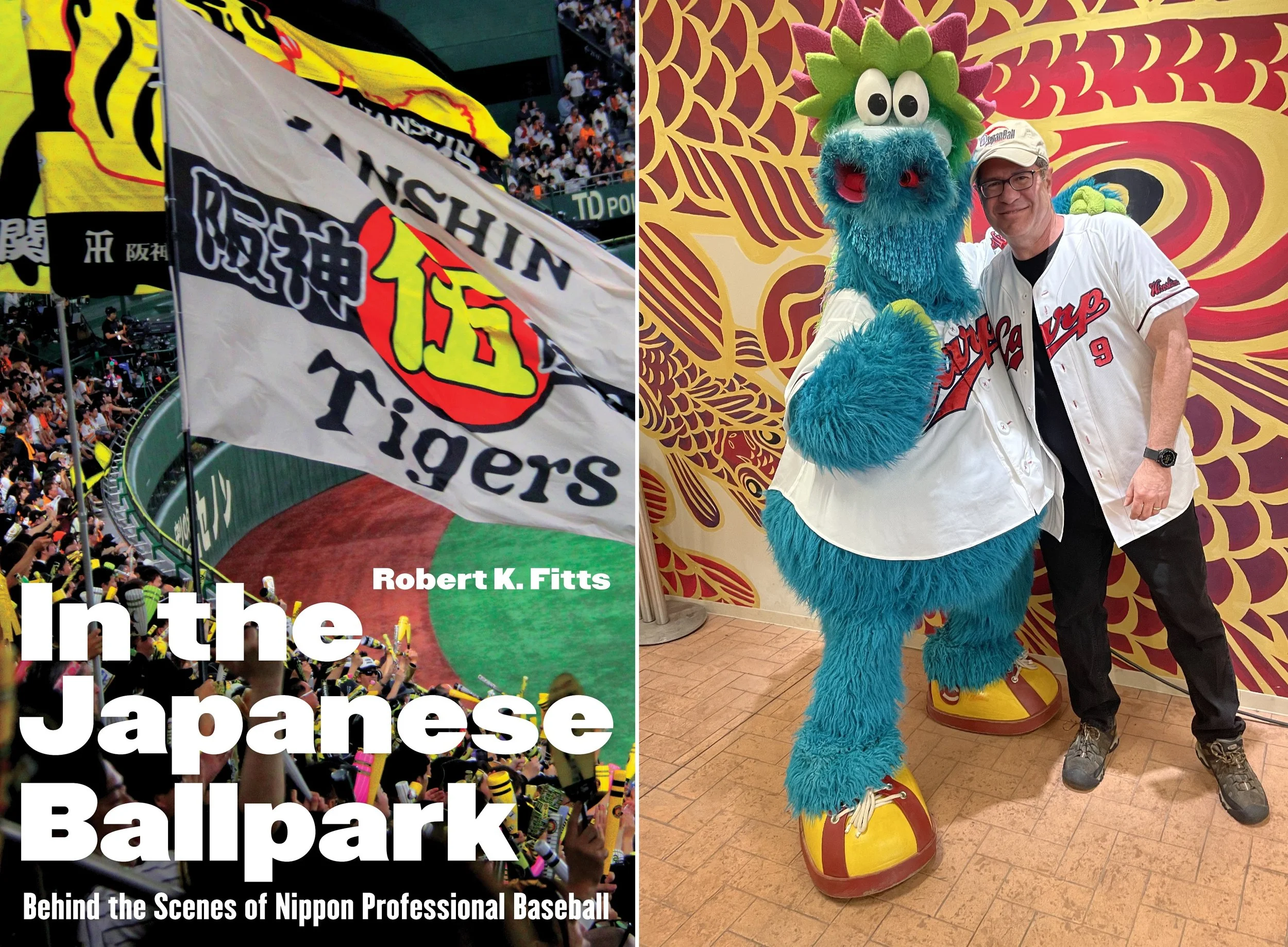
That was 1993, and since then, Fitts has written eleven books on Japanese baseball, the most recent being this week’s release In the Japanese Ballpark: Behind the Scenes of Nippon Professional Baseball (Nebraska) which features interviews with professionals across Japanese baseball, giving readers a snapshot of how Japanese baseball works.
In the Ballpark is a perfect introduction to Japanese baseball for the novice and a great read for fans who want to know more about the lives of those who work at every level of NPB. In the following conversation, Fitts speaks to how the book came about, which interview surprised him the most, and where folks who are interested in NPB can get started.
How did the idea for this book come about?
I've been writing books on Japanese baseball for 20 years. I went to Japan in 2023 on an organized tour of all 12 stadiums. The first day out there, it's a hot day, and I want a beer. In Japan, of course, they have beer girls. You don't go to the concession stand to get a beer. Somebody brings it to you, and they pour it from a keg on their backs right in front of you. I get my beer, and I say thank you. I start watching the game. Then as the innings go on, I see this young lady running up and down the stairs again and again and again. It must have been 98 degrees that day. It was horrible. I was like, “My gosh, what is her job like?” Then I started thinking about the other people in the ballpark, the people who work on the field, even the umpire. What is their day-to-day job like?
Japanese baseball is so different from American baseball, or at least the atmosphere is so different that I started asking, ‘What makes Japanese baseball different, and how are their jobs different than they would be if they were working in the United States?’ When I don't know something about Japanese baseball and I'm interested, what do I do? I write a book about it to really get into it for a couple of years and start finding the answers to these questions I have.
I started reaching out to people. It took about six months finding people from various occupations who would be willing to be interviewed. I got about half Americans and half Japanese. I did that on purpose. Firstly, because the Americans are easier for me to interview. I do not speak Japanese. I speak tourist Japanese, so I can't do an interview. I used an interpreter for those. Also, the Americans who worked in Japanese baseball were usually familiar with American baseball and Japanese baseball. They understood the differences and could convey that to me. Whereas the Japanese people often didn't really understand US baseball, but they, of course, had insights into their own culture that as a foreigner, you don't get. By splitting them half and half, I think I was able to get a better, more well-rounded answers of what makes Japanese baseball different from American baseball.
How did you decide to use, as opposed to the straight interview format, this more essay-based form?
My very first book follows a similar format. That book is called Remembering Japanese Baseball. It's about 30 interviews of former players, starting with the 40s, going all the way to, at that time, 1990. I get them to talk about their careers. That book is based on one of the all-time great baseball books, which is called Glory of Their Times. It's an oral history written as narratives of the players who played in the early part of the 20th century. I liked the format so much that I did it again with this book.
What's your editing process like?
This time, I did almost all the interviews on Zoom. That allowed me to create an AI transcript. I also tape-recorded them. After I did the AI transcript, I would go back with the tape recorder running and correct it. I would say the AI got about 90% right, but they often put the punctuation in the wrong place, changing the whole meaning of the sentence. That would take days to get an accurate transcription. At that point, then I would start reading the transcription and say, “All right, what's interesting here?”
These were hour-to-two-hour interviews, so I would have 10,000 to 20,000 words per person. I had to get them down to about 3,000 words. I'd pick out the parts that were most interesting and focus on them. Then start cutting and pasting and deleting until I got what I thought was an interesting story. I'd have to set out these answers in a logical manner because I remove my questions. The idea is that you should feel like the person is sitting next to you in a bar with a mug of beer, and they're telling you about what it's like to be in Japanese baseball. That's the goal of each chapter.
When I do these narratives, I send it back to the person. I say, "Did I get everything accurate? Are you comfortable with what you said to me over Zoom, seeing it in print? Also, would you please correct any of the prose that just feels really awkward?” That way, when we're done, we have a product that the people are happy with. Yes, you get some good stuff removed every now and then where they say, "Oh, I shouldn't have said that," but it's the price to pay.
How did you decide who you were going to talk to for each position?
It was pretty much access-based. Some of the people were really hard to find. For example, a beer girl was very difficult. You found beer girls at every ball game, you'd think it would be easy, and most of them were college students. But because they were college students, they were busy. They were under contract with either the stadium or the beer manufacturer. Some of them weren't allowed to speak to press people. That took months and months until I found someone who would speak to me.
It took a long time to get a mascot because in Japan, they like to keep up the premise that the mascot is a real entity, that there's not a person inside of it. I wanted to interview the Hiroshima Carps mascot, Slyly. He's my favorite mascot. It just so happened that I was able to identify some of the actors through LinkedIn. I started talking to them, and they said, “You have to talk to the Carps. We're not going to do this without the Carps' permission.” What finally came down was that I'm not allowed to interview the actor, as an actor. I can only interview the person talking about the mascot. The person in my book, of course, is the mascot, but he's never labeled as the mascot in my book. He talks about the mascot in the third person. That was, I thought, fascinating.
The other people I found were people I had already been in contact with or friends of friends. Sometimes I just went on LinkedIn and wrote in “Marketing, Yomiuri Giants.” Sent out three or four cold emails. Eventually, people came back to me.
You're writing about a culture that you didn't grow up with. You don't speak the language. How were you navigating that cultural divide?
That can be difficult. I did live in Japan for two years, and I go back all the time. I have many Japanese friends. I don't find the cultural divides to be as large as some people do. I have found, especially from living there, people are people. When you connect with people, yes, there's cultural differences, but usually you can communicate, I think, accurately and honestly, even through an interpreter, with many people you meet. However, because I do have a lot of Japanese friends, I ask a lot of questions.
Just last week, I was writing something for a talk I'm giving on the concept of booing and heckling. I was starting to write, “there is no booing in Japanese baseball.” I ran it by someone, and they said, "Well, you know what? Yes/No." I said, "Why is there no booing?" The answers from my Japanese friends really astounded me. They said, “Because Japanese don't boo. We don't have a word, boo.” If they want to show displeasure, unless they've been watching a lot of American movies and sports, a Japanese person won't boo. They may heckle, they make other sounds, but they don't boo. There's an example of, okay, my entire question was off. I really trust a close group of friends, who are my friends outside of baseball as well as in baseball, to give me good answers. They always do. They're always so generous with their time.
What is it like to work with an interpreter?
I've used three interpreters during all my books, Ami Shimizu, Keiko Nishi, and Trevor Raichura. I like to use the same interpreter for each book. Usually, it just works out that way. Certain people are available. You hire them for the whole book because then there's a continuity of the project and also the types of questions I've asked other people. Often, my interpreters will ask me permission to ask other questions.
I remember two books ago, I did a biography of Masanori Murakami. He was the first Japanese to pitch to the major leagues. I was interviewing his wife. Murakami's wife is awesome. Now, I know her reasonably well. The first time we met it was pretty awkward. I wasn't getting really good answers. I was getting very short answers, embarrassed answers. Finally, [Keiko Nishi] turned to me and said, ''Do you mind if I ask some questions?'' I said, ''Yes, go ahead.'' She started asking more family-oriented questions. His wife, who was in her 70s, lit up and then started being more talkative.
Then my interpreter worked her back a little bit to what was life being a mom with a baseball player. My interpreter knew me well enough and had done enough interviews at that point that she felt comfortable knowing what I would want. It was a great interview because of the interpreter. When you get a good interpreter, it's just great.
Was there any hesitancy with getting Japanese interviewees to speak for a book that's aimed at a Western audience?
No, the opposite. For a number of people that I spoke to, people who are working within organizations, I had to go through a lot of red tape to get the interview, which included sending my questions to the PR department before they granted me permission. Several of the people or the PR department heads asked me, "Is this for English only or do you have plans to publish this book in Japanese?" I said, "Honestly, at this point, it's only for English because the book is really written for Americans who are interested in Japanese baseball." All three of them answered, "Good."
I think they were a lot more open to speak with me because they knew it would not be coming back in Japanese. I think there were some things in the book - there's nothing earth-shattering in the book, but I think some people were probably blunter in English to me than they would have been if they were talking in Japanese.
Which interview surprised you the most?
I think probably the interview with the cheerleader. When I was coming up with who to interview, I wanted to have a number of women present in the book. Cheerleading is also something that's not done in MLB, so I thought, "Well, I should talk to a cheerleader." Quite honestly, I never really paid much attention to the cheerleaders. I didn't think this would be such a great interview. I thought, "Well, I should just have a cheerleader in there. We'll see how it goes."
The woman I interviewed, [Saori Ogure], was fascinating. The life of what it's like to be a cheerleader, what they go through, how they train, how they try out. One of the interesting things I found in the book was the cheerleaders have to re-tryout every single year. Even if they've been on the squad for five or six years, they still have to go to the auditions and try again.
That was one of the best interviews from my perspective.
If you were encouraging someone who has never watched any NPB to get into NPB, where would you recommend they start?
If they have to start fresh, I would go to the different YouTube channels. I would read a little bit on JapanBall.com, a little bit on Reddit NPB server. There's a lot of basic information out there. Then I would go to YouTube. You can watch some old games that are probably up there illegally, but they're there. You can watch some very good short documentaries. There's a couple of people who work in English who talk about the history of Japanese baseball. These are excellent, short films or short videos.