Cranklets, Lost Diamonds, and the history of non-male figures in baseball
An interview with baseball cartoonist Ellen Lindner
Ellen Lindner
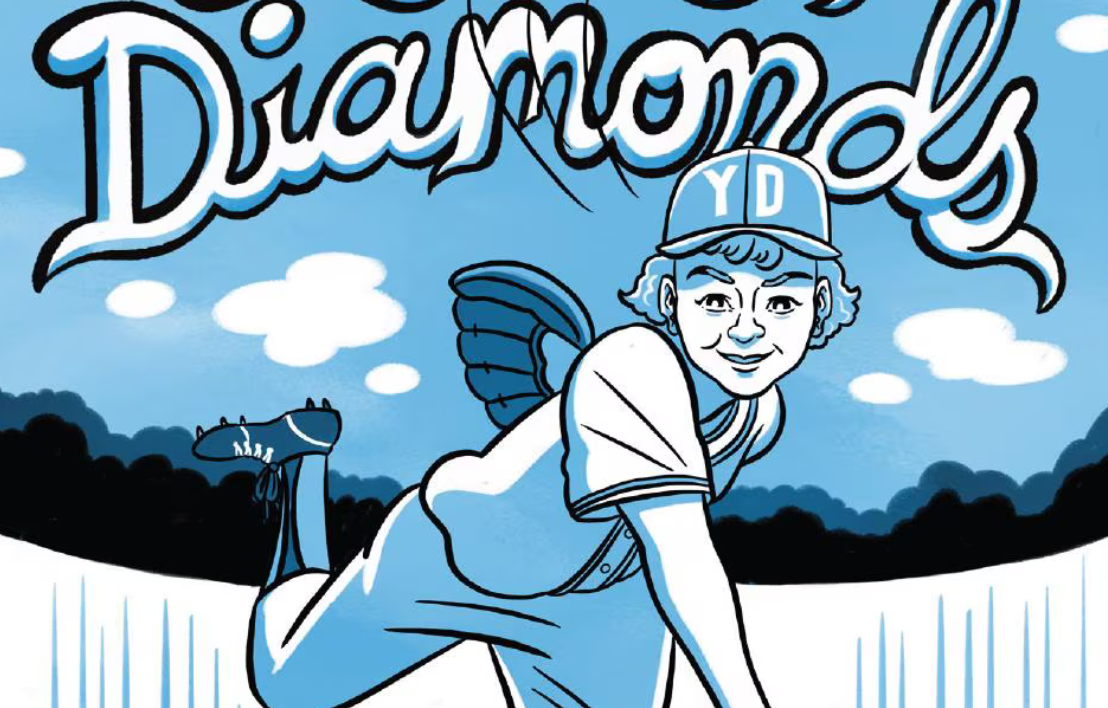
Ellen Lindner is an Ignatz-nominated cartoonist with comics in The Washington Post and MoMA.org. Her baseball-centric comics Lost Diamonds and Cranklets tell the oft-forgetten histories of non-male figures in baseball. In the following conversation, Lindner and I chat their personal history with the sport, with the form of comics, and the complicated (and long) relationship between baseball and gender.
What’s your personal history with baseball?
I never knew that I was a baseball fan because baseball was just always on. It was just part of the landscape, part of the atmosphere of my childhood. When I was a kid, we used to go every Sunday to my grandparents' house in Queens Village, and the Mets would always be on.
I always joke that I was brainwashed into becoming a baseball fan. Now that I've tried all those other sports, it's still the one I keep coming back to, although it increasingly makes me crazy, especially as a Mets fan. I definitely feel a lot of guilt about converting my spouse to baseballism, baseballology, because he's from the UK. He has no experience with baseball previously, but he's now a Mets fan, basically as a cultural thing because a lot of the people we hang out with are Mets fans.
I feel a lot of guilt about that, but it's too late. He's an adult. He can make these
When did you get into comics?
When I was a kid, my family only read The New York Times, but my grandparents got the Daily News. The Daily News had a lovely color comic section every Sunday. I think that was my first experience of comics. I think over time, I've realized that I really like writing. I really like drawing, painting, and creating visual art. If I just do the drawing and painting part, I feel very frustrated, and if I just do the writing part, I feel frustrated.
For me, even though it's a medium that's always resonated with me, it also works with my brain chemistry. It's this ambidextrousness that comics does so well. As humans, we love words and pictures. Comics is very retro in some ways. The lack of any motion, the use of these time-worn visual tropes. It's not the most advanced medium, maybe, but it's one that I find really satisfying to work in, and which I think for nonfiction really works well because, often with comics, you'll read it through once, and then you'll go back to it, which is much harder to do with, for example, a documentary.
With Lost Diamonds, I like to think that folks might use them as mini-reference tools. The new issue of Lost Diamonds, for example, deals a lot with Title IX and baseball, and why Title IX didn't help to bring about some greater level of gender integration within baseball culture. Even though it happened at the same time as young AFAB [Assigned Female at Birth] kids being admitted back into Little League.
I would hope that if someone is curious about a capsule biography of Toni Stone or a short description of why the Dodgers left New York City, I think comics can actually be a really great mnemonic in some ways, a great reference point because you do have the visual and the verbal frozen in place.
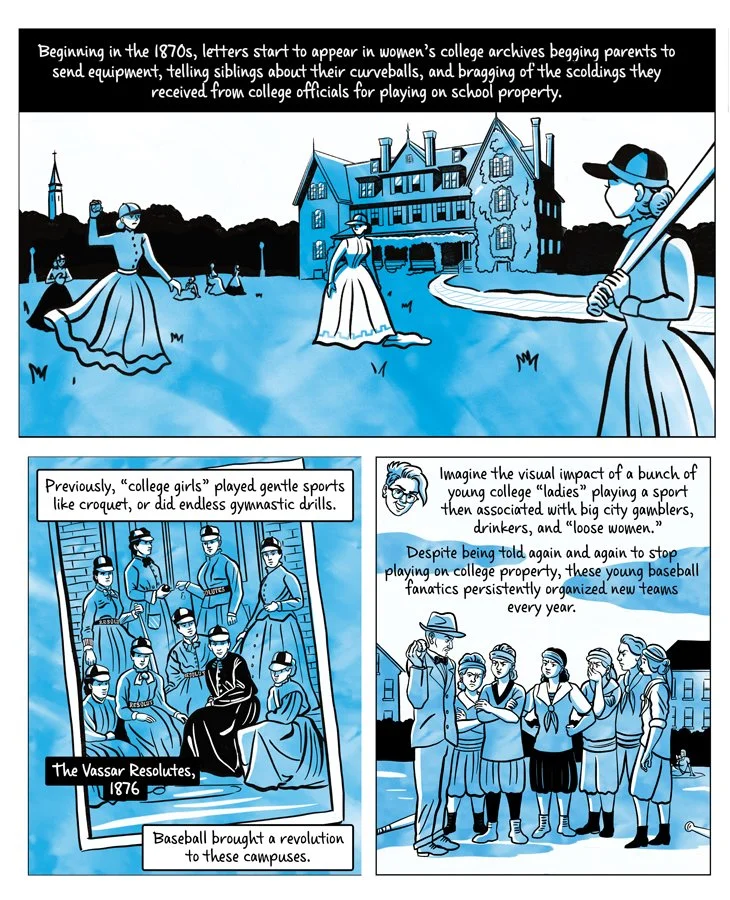
There aren't a lot of reference points specifically about gender and baseball. people who have created this world - Barbara Gregorich comes to mind, Dr. Leslie Heaphy, so many great authors -- The people who laid the groundwork for this are phenomenal. I'm just trying to give back a little bit. It's like cliff notes for gender and baseball history.
Ellen Lindner
You obviously have a previous interest in this, but what led you to start making comics about non-male baseball figures?
I lived in the UK for eight years. It was roughly between 2004 and 2012. At that point, at least I didn't know how to stream games. I didn't know how to really keep up to date on watching baseball. It was essentially a long break from baseball. I would keep tabs, but I didn't really know that much about what was going on.
When I came back from the UK, I saw that there had been progress in all these other sports. The WNBA was blowing up. WSL was doing really phenomenally well. The US Women's National Team in soccer were iconic. Baseball had not moved on at all, from what I could tell. It was really quick to celebrate the infinitesimal gains it had made, but it had not done anything on the level of the other sports that I was a fan of. Baseball was just a bunch of dudes still. It was less gender-integrated than the Catholic Church.
I was working on a historical graphic novel. It was a mystery set in London called Black Feather Falls. When I finished that, I was looking for new projects. I just decided that if I was going to be a fan of baseball, I really had to dig into this stuff. I didn't want to be blindly following this culture without knowing the nitty-gritty backstory. Actually, I was shocked at how little I knew about baseball in terms of its history. At that point, I'm not even sure I could say I'd sat through the entirety of the Ken Burns baseball documentary. If it had not been on a Mets broadcast, I would not know about it.
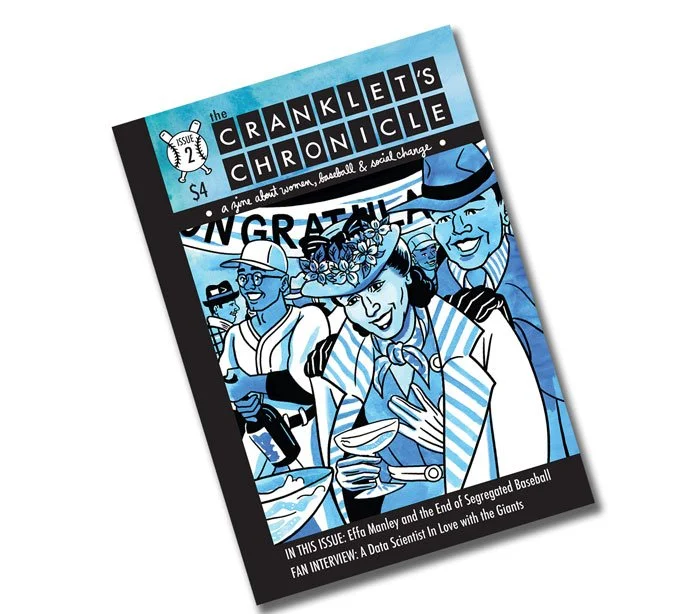
I started doing a comic specifically about Joan Whitney Payson, who was the founding owner of the New York Mets. I wrote about her in the first issue of this comic I did called The Cranklet’s Chronicle. I'd watched the Mets my whole life, and I had no recollection of them ever mentioning that the first owner was a woman. Never mentioning that she was the first woman to buy a baseball team with her own money. Basically, from there, I started digging into her history.
Again, my lack of any knowledge struck me again and again. For example, it turned out that in addition to being a foundational baseball owner, an absolutely trailblazing woman in baseball, she had also founded the hospital where I was born on Long Island. She was my mom's boss, basically. My mother was working at that hospital during the 1969 World Series, which the Mets won, which changed their course as a franchise.
You drew this great panel where the nurses are sitting and listening to the game.
I had to bring it in because, A, it's how I became a Mets fan. If my mom wasn't a Mets fan, I wouldn't be a Mets fan. B, because it's this really weird overlap between my personal history, my family's history, and the history of this franchise. From there, I did a comic about Effa Manley in the same series. Whenever I was selling comics at comics conventions, people would be asking me about, “Oh, I know about women in baseball. I saw A League of Their Own.” I think we need to own our own ignorance on a certain level. The thing is baseball culture fosters that ignorance because it doesn't encourage that kind of discussion.
I recently was watching a video about the Savannah Bananas who occasionally employ female or female-identifying players. Someone in the comments said something like, "Oh, it's so cool that they have women on the team, but they're not preachy about it." It's like, okay, so we're just devalorizing any discussion whatsoever of gender because if gender is involved in the discussion, automatically someone is being preached at. Maybe that's true, but can't we just try to have that discussion once?
I do feel like with Major League Baseball in particular, they just want you to look away. They're like, “Hey, we have merch for women and we love female fans because they have money, but we don't really want to talk about any sort of concrete gender integration within baseball culture.”
It's hard not to get cynical about this stuff. Basically, to answer your question, all of these roiling issues prompted me to express myself about this the way that I feel comfortable and the way that I've trained myself to, which is to make comics about it, and then make people buy them.
Ellen Lindner
Tell me about how you do your research.
I teach a class called Senior Project Research. For a lot of my students, they don't have any experience of going to a library, even. A lot of art students, they feel more comfortable with visuals. Anything textual, they get unnerved. I even had a student say, why would I look at a book? I was like, well, friend, I have a solution for you, which is that you live in a city where you can ask a librarian anything, and they are paid to help you.
When I started doing my research, I went to my safe space, which is the New York Public Library. I just started looking for books about Joan Whitney Payson, and there was nothing. At some point, I figured out that there was this amazing website called newspapers.com, which is so goofy. It's, in some way, the goofiest website. However, it has been an absolute godsend.
When I read about people, early baseball researchers who would spend their summers just literally driving from archive to archive, because none of this was digitized, I really thank my lucky stars for stuff like JSTOR, newspapers.com, the digital resources of the New York Public Library, digital archivists. I do often bug the folks at the National Baseball Hall of Fame and Museum in Cooperstown, and they've been extraordinarily helpful. They'll send me PDFs about teams with resources that I didn't even know existed. I do lean very hard on librarians and archivists for help.
Cranklet's Chronicle was different because each issue was its own thing, and so I could research a topic and then put a fork in it, and that was it. Whereas with Lost Diamonds, it's trickier because I'm always getting new information. I've become a real spreadsheet nerd. I'm constantly throwing stuff into these spreadsheets so that I can keep everything organized because otherwise it gets so crazy with stuff that people are telling you, with stuff you find. Also, there's stuff happening all the time.
At the moment, I'm researching Lost Diamonds 5. Lost Diamonds 4 roughly covered from 1955 to 1974. Lost Diamonds 5, at the moment, will cover from 1975 to 1995, which feels so weird because this is getting into my lifetime, finally in the Lindner years. For that, at the moment, I am literally going on newspapers.com and just typing in-- the search terms are wild, but I'm trying to speak in the language of the time: girls' baseball or girls' Little League.
Then I'll put in a brief date range, so something like 1975 to 1980, and then a state. I'll just go through all the stories about girls in Little League in Maine, all the stories about girls in Little League in Vermont, all the stories about girls in Little League in New Hampshire, and just work my way through the country. I find that's the only way of getting this stuff down because, otherwise, a lot of books and websites gloss over big periods.
A League of Their Own is still the top-grossing baseball film in history. Basically, when folks in publishing see that, they're like, okay, that's what sells. We're going to really focus our resources on this time period. The thing is, there's so much other fascinating stuff. Reading about all these young AFAB kids who were the first girl on their team-- for example, in the current issue of Lost Diamonds, I did something which I really love to do but haven't been able to do until this chunk of time because the people who are living it are still alive. I was able to interview a filmmaker named Melanie Hope, who's also a lawyer. She was one of the first AFAB kids to play baseball in New Jersey after the ban on AFAB kids in Little League ended.
Talking to her was really eye-opening. First-person interviews are huge. I also really enjoyed talking to Mel because a lot of the record in the press is exclusively of white kids. It might as well just say, first white girl in Little League. In America, it's really hard to talk about race, but I do want my comics to be reflective of as many people as possible. It just happens that Mel is a Black woman, a proudly queer Black woman. Her experience was of growing up in a suburb in New Jersey, very similar to the one I grew up in. She grew faster than her brother. She was always really good at sports. She was an all-star throughout most of her Little League career.
She just saw it as part of growing up. That was just the beginning of a lifetime in sports. Two of her kids are professional athletes. They play professional soccer. She still plays in a women, trans, and non-binary team in Brooklyn, which is how we met.
It’s a mix of archival research, often focusing on contemporary news accounts, because the stuff people say in these editorials, in particular, are wild. People just straight up saying, “Girls should not be in Little League.” Why? Because I have feelings. It's never about facts. I love being in Little League as a boy, and if girls come in, it'll be different. People would write that shamelessly.
My undergraduate degree is in art history, and art history is just library research 24/7. Being able to do stuff in the present day, like going to the WPBL tryouts, that's something I can't do about the St. Louis Black Bronchos or the Kansas City Monarchs of the 1950s. I would love to have a beautiful time machine, but the technology is not with us yet. That's been a really cool turn with the last issue, being able to talk to people.
There is a lot of lost history there. In the present day, we just have more grist for the mill, so to speak. There's just way more photographic imagery. You can talk to people on social media. It's a whole different situation.
Actually, the last issue gave me a lot of anxiety because I was just like, I don't know how much is out there. I know how much is out there about the AAGPBL, I know how much is out there about Tony Stone, but I don't know how much is out there about the specific relationship, for example, between Title IX and baseball.
The unknown unknown.
Oh, yes. I was like, I know I don't know anything about this. This is crazy. Also, I was like, what about the dark years when AFAB kids couldn't play in Little League? How was that documented? It turns out there's actually a lot of documentation because there were a lot of lawsuits. When things go through the courts, that makes the news, especially if it's a man bites dog story like, “This girl wants to play baseball.” Always in the most incredulous tone like, “Why would she want to do that?”
To read more about Ellen Lindner’s work or to purchase her comics, head over to her website.