Jackie Robinson’s Childhood Home
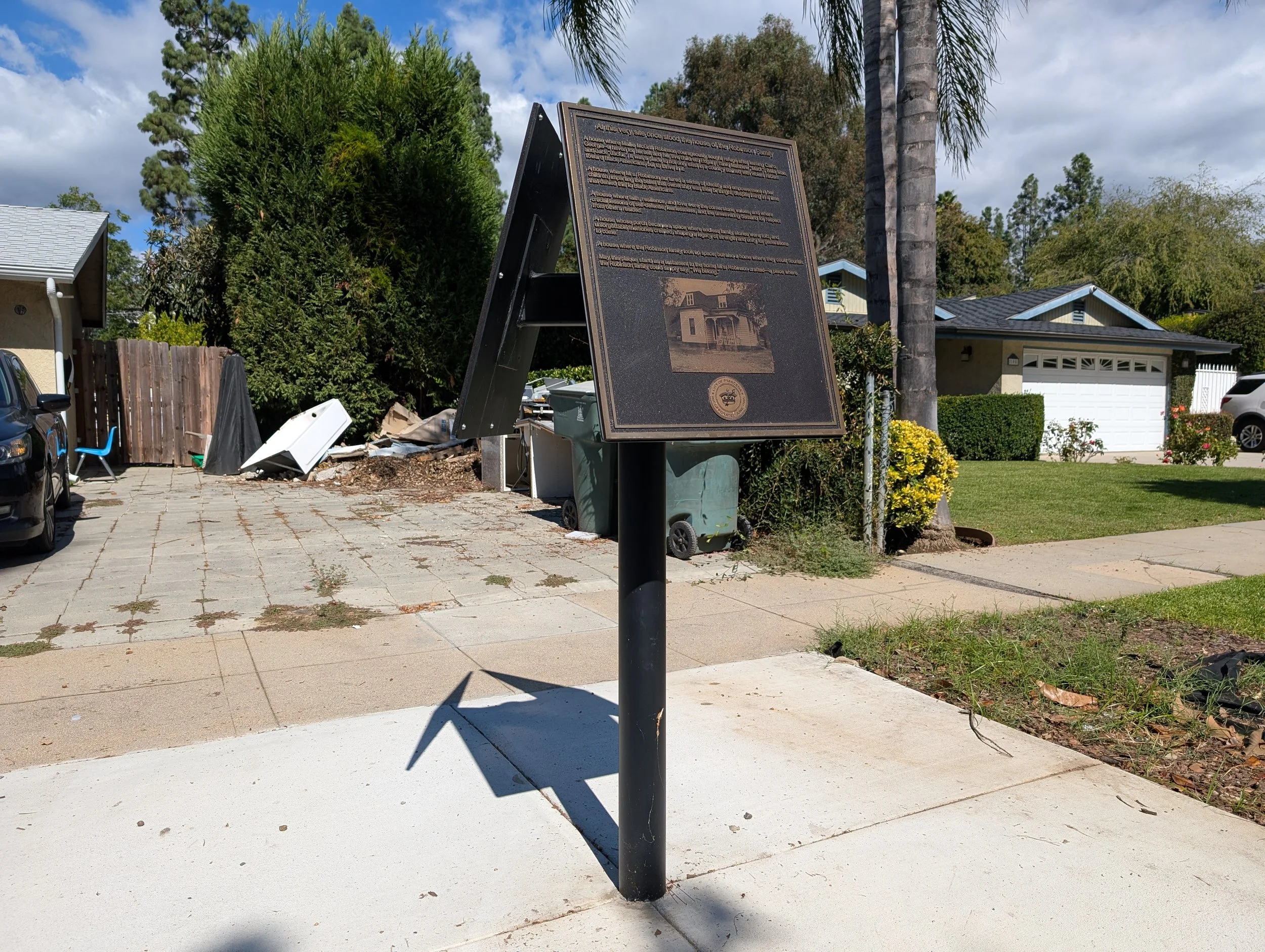
I recently had a chance to visit the site of Jackie Robinson’s childhood home, which was torn down in the 70s. I was visiting to check out the new plaque placed there by the city of Pasadena. The new plaque, like many of Pasadena’s Robinson memorial sites, is not focused solely on Jackie Robinson’s baseball achievements, but on his entire life as well as his family’s. Before the new memorial, there had been a flat plaque placed on the sidewalk which, on an already unassuming street, did not stand out much. Through the campaigning of historian Okeyo Jumal, a standing three-plaque marker was installed in 2024.
Each of the three plaques takes on one aspect of the Robinson legacy. As you walk towards the house, the first plaque tells the story of the Robinson family. “At this very site once stood the house of the Robinson family,” it reads, “A house where Mallie McGriff Robinson courageously sought refuge after leaving Cairo, Georgia – a haven for herself and her five children: Edgar, Frank, Matthew “Mack”, Willa Mae, and Jack “Jackie”.” That this plaque is the first that you read when approaching the memorial recontextualizes Jackie Robinson’s story beyond the courage he showed during his career and expanding to feature the courage that his mother showed when Jackie and his siblings were only children.
On the left side plaque are two photos of Jackie and Mack Robinson, as well as quotes from each. Jackie’s famous quote reads, “I’m not concerned with your liking or disliking me. All I ask is that you respect me as a human being,” and Mack’s reads, “Learn to finish what you set out to do.”
The final plaque is dedicated to Mack and Jackie’s biographical information and sporting careers, touching on details of their college experience (where Mack set junior college records in track and field and Jackie lettered in five sports), Mack’s Olympic career, and finally Jackie’s baseball career, as well as Jackie’s activism.
As I left the memorial, I read up a little on the Robinson family’s time in Pasadena and learned that they were heroes, long before Jackie Robinson broke baseball’s color barrier. During World War II, the Robinsons’ Japanese American friends, the Takayamas, were either serving in the US military or interned at Gila River. While many homes of Japanese and Japanese American families were robbed or vandalized, the Takayamas’ home was well kept, something that Joan Takayama-Ogawa credits the Robinson family and other neighbors with.
These stories are just as important in understanding Jackie Robinson’s legacy as any other part of his history. As for how the city remembers its history with Jackie Robinson, Mayor Victor M. Gordo said to The Fan Files, “Jackie Robinson changed the game of baseball, and the course of American history. His courage and integrity on and off the field continue to inspire not just athletes, but all of us who believe in fairness and opportunity. The Robinson brothers’ legacy of excellence and service to others is woven into the fabric of our city, reminding us every day of the power of perseverance and purpose.”
Pasadena is also home to the Jackie Robinson Community Center, Robinson Park Recreation Center, and Jackie Robinson Memorial Field. Next to city hall, there is the Pasadena Robinson Memorial, which features two large busts of Jackie and Mack Robinson, with Jackie facing New York, and Mack facing home. The sculptors behind the memorial write in their artist statement that the memorial is not a sports memorial but a memorial of the brothers as men.
Photos and full text of all three plaques below:
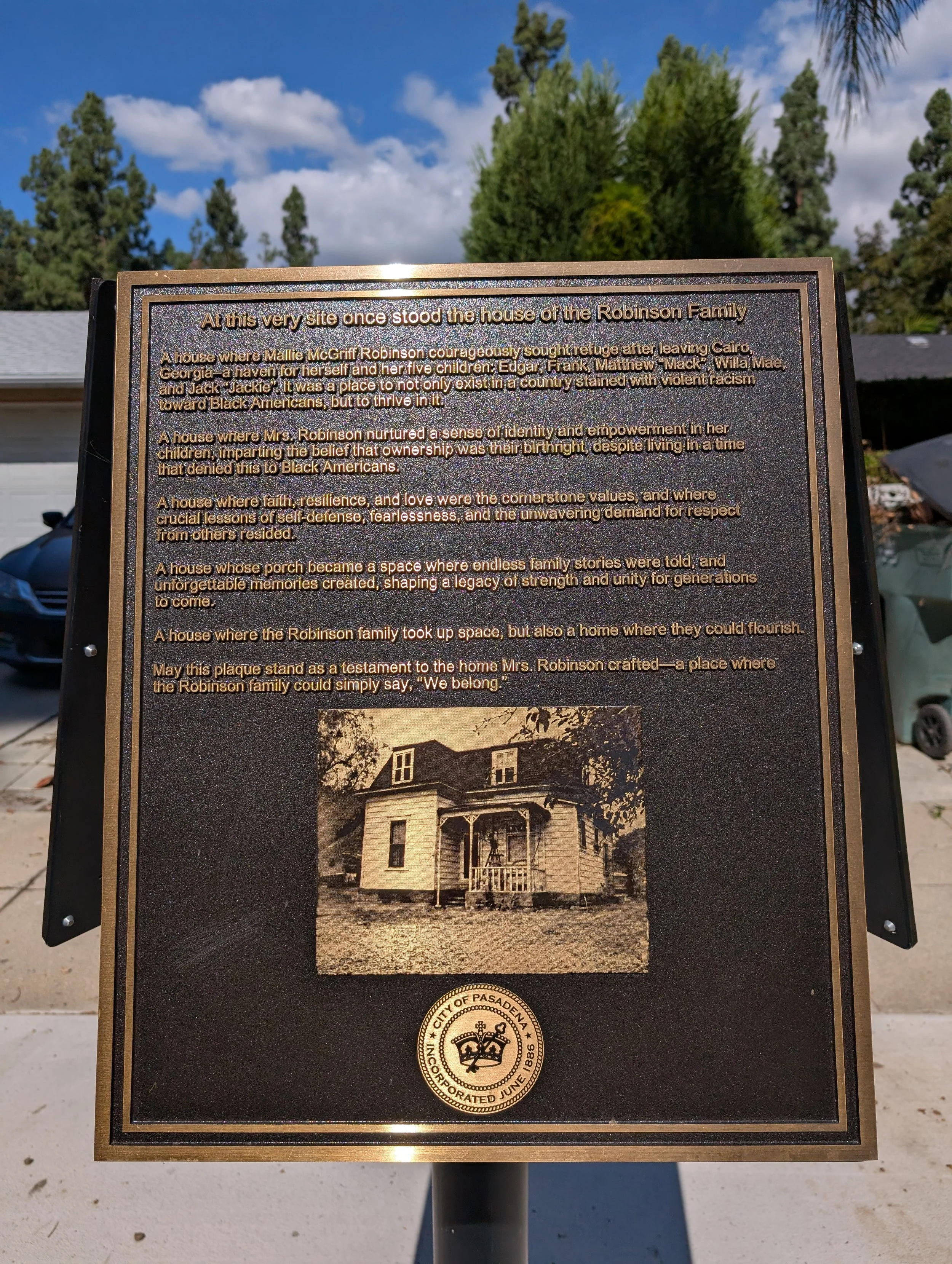
At this very site once stood the house of the Robinson Family
At this very site once stood the house of the Robinson family. A house where Mallie McGriff Robinson courageously sought refuge after leaving Cairo, Georgia – a haven for herself and her five children: Edgar, frank, Matthew “Mack”, Willa Mae, and Jack “Jackie.” It was a place to not only exist in a country stained with violent racism towards Black Americans, but to thrive in it.
A house where Mrs. Robinson nurtured a sense of identity and empowerment in her children, imparting the belief that ownership was their birthright, despite living in a time that denied this to Black Americans.
A house where faith, resilience, and love were the cornerstone values, and where crucial lessons of self-defense, fearlessness, and the unwavering demand for respect from others resided.
A house whose porch became a space where endless family stories were told, and unforgettable memories created, shaping a legacy of strength and unity for generations to come.
A house where the Robinson family took up space, but also a home where they could flourish.
May this plaque stand as a testament to the home Mrs. Robinson crafted- a place where the Robinson family could simply say, “We belong.”
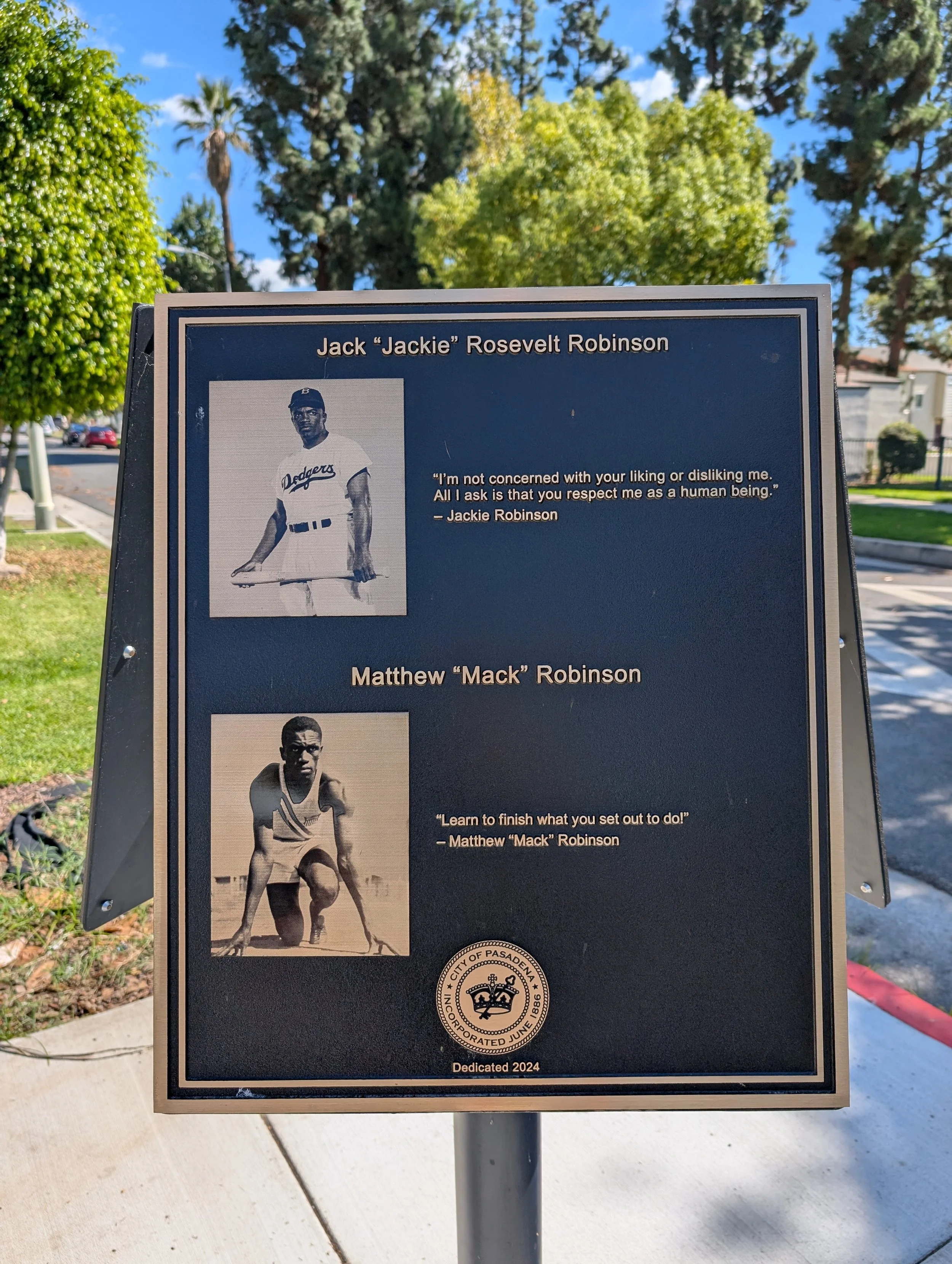
Jack “Jackie” Rosevelt Robinson
“I’m not concerned with your liking or disliking me. All I ask is that you respect me as a human being”
- Jackie Robinson
Matthew “Mack” Robinson
“Learn to finish what you set out to do!”
- Matthew “Mack” Robinson
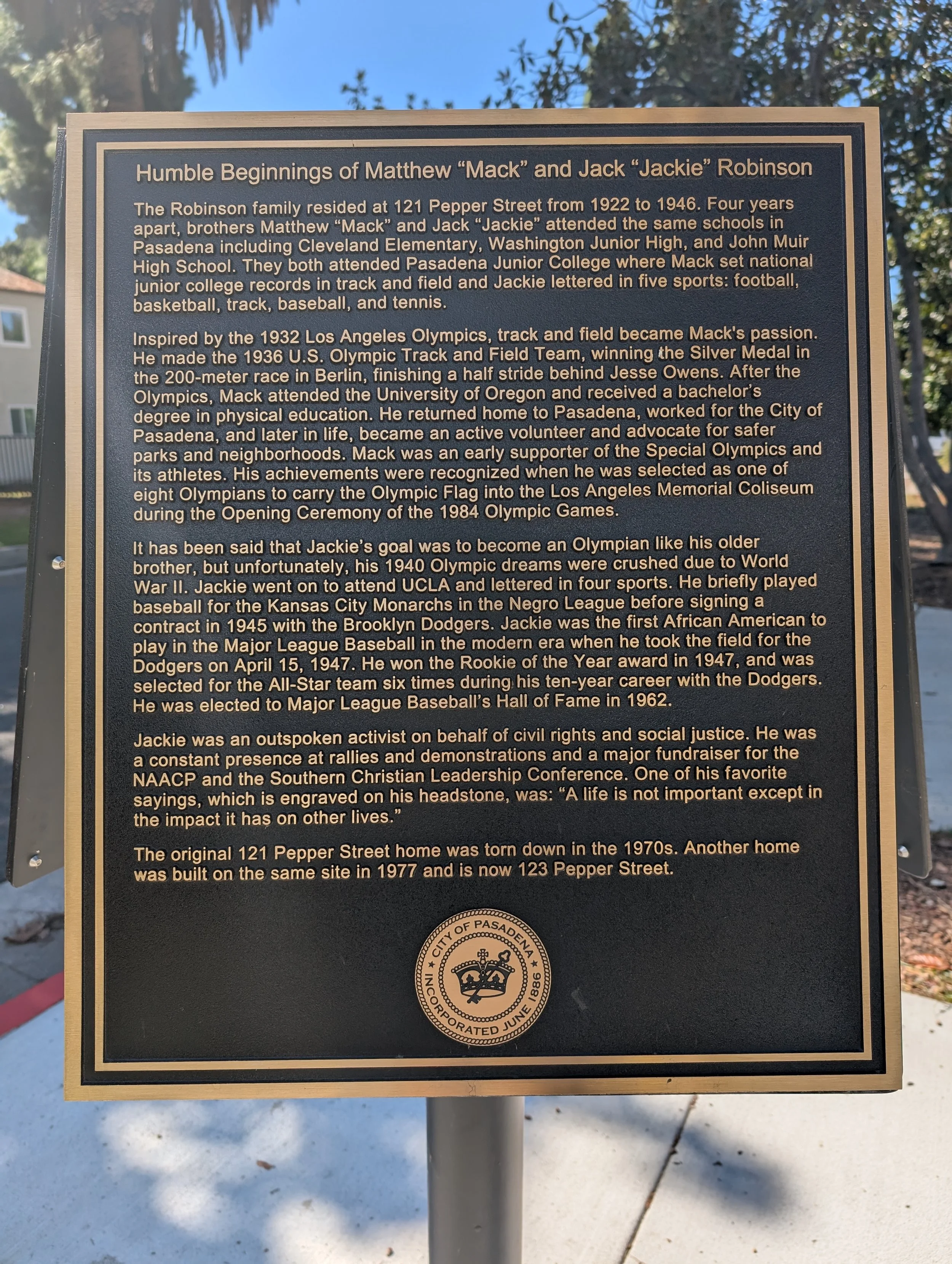
Humble Beginnings of Matthew “Mack” and Jack “Jackie” Robinson
The Robinson family resided at 121 Pepper Street from 1922 to 1946. Four years apart, brothers Matthew “Mack” and Jack “Jackie” attended the same schools in Pasadena including Cleveland Elementary, Washington Junior High, and John Muir High School. “They both Attended Pasadena Junior College where Mack set national junior college records in track and field and Jackie lettered in five sports: football, basketball, track, baseball, and tennis.
Inspired by the 1932 Los Angeles Olympics, track and field became Mack’s passion. He made the 1936 U.S. Olympic Track and Field Team, winning the Silver Medal in the 200-meter race in Berlin, finishing a half stride behind Jesse Owens. After the Olympics, Mack attended the University of Oregon and received a bachelor’s degree in physical education. He returned home to Pasadena, worked for the City of Pasadena, and later in life, became an active volunteer and advocate for safer parks and neighborhoods. Mack was an early supporter of the Special Olympics and its athletes. His achievements were recognized when he was selected as one of eight Olympians to carry the Olympic Flag into the Los Angeles Memorial Coliseum during the Opening Ceremony of the 1984 Olympic Games.
It has been said that Jackie’s goal was to become an Olympian like his older brother, but unfortunately, his 1940 Olympic dreams were crushed due to World War II. Jackie went on to attend UCLA and lettered in four sports. He briefly played baseball for the Kansas City Monarchs in the Negro League before signing a contract in 1945 with the Brooklyn Dodgers. Jackie was the first African American to play in the Major League Baseball in the modern era when he took the field for the Dodgers on April 15, 1947. He won the Rookie of the Year award in 1947, and was selected for the All-Star team six times during his ten-year career with the Dodgers. He was elected to Major League Baseball’s Hall of Fame in 1962.
Jackie was an outspoken activist on behalf of civil rights and social justice. He was a constant presence at rallies and demonstrations and a major fundraiser for the NAACP and the Southern Christian Leadership Conference. One of his favorite sayings, which is engraved on his head stone, was: “A life is not important except in the impact it has on other lives.”
The original 121 Pepper Street home was torn down in the 1970s. Another home was built on the same site in 1977 and is now 123 Pepper Street.