Do Managers Even Matter Anymore?: An Interview with Scott Miller
Grand Central Publishing
Disclosure: This article contains affiliate links, meaning The Fan Files will receive a small commission if you choose to purchase through any of the below links.
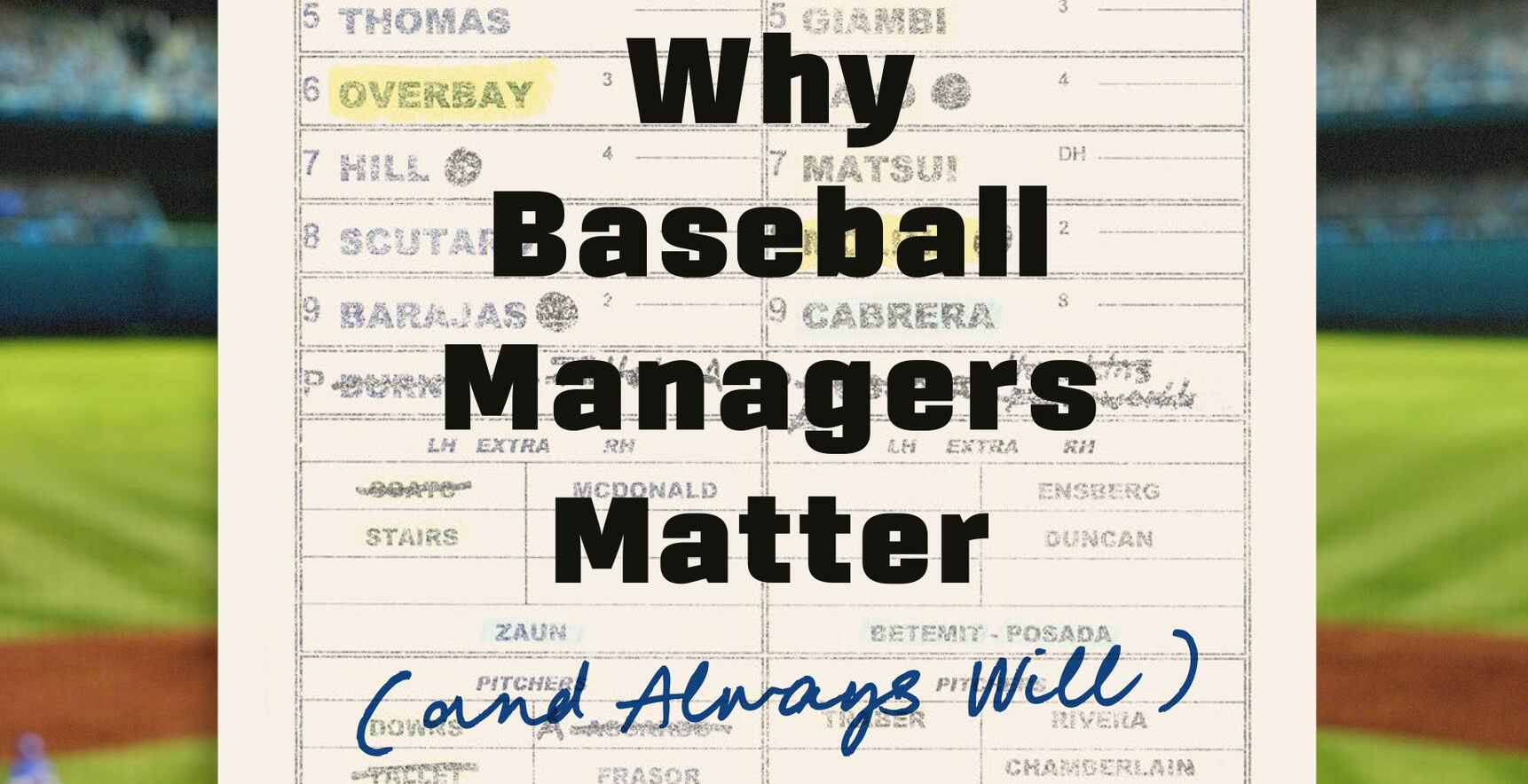
The job of a baseball manager has changed a lot over the years. Out are the days of “my way or the highway” managers and in are the days of the media savvy, front office collaborating, manager. Scott Miller’s new book Skipper: Why Baseball Managers Matter and Always Will follows the introduction of modern technology to the American pastime and how that sea change has impacted the role of the baseball manager.
In the following conversation, Miller and I chat the characteristics of the modern manager, tidbits that didn’t make it into his final book, and how Dave Roberts helped him make one last minute change before the book went to press.
Why a book about baseball managers and why now?
As analytics has changed the game, a manager's job is more and more dissected, and over the last 10 years or so a lot of people are starting to diminish the manager's job saying, "The front office baseball analytics people make some decisions, manager goes along with things.”
I had co-written Ninety Percent Mental with Bob Tewksbury a few years back. I was looking around for a next project. It takes two and a half years or so to interview and to write, so it has to be something interesting if you're going to spend that much time on it. I've covered the game for so long, I just happened to develop some pretty good relationships with a number of managers over the years. I thought it'd be interesting to look at.
You mentioned it takes about two and a half years to put together a project like this. Baseball managing is a very broad topic. How do you break it down?
I was going along a timeline. I started about the time computers started, late '70s because, obviously, computers have changed all of our lives. What was the managing job like then? What's it like now? How did we get from then to now and why? Earl Weaver, Sparky Anderson, and Tom Kelly. Those guys just ruled with the iron fist. Whatever they said went.
Basically, in those days, the front office, their job was to build the roster and turn it over to the manager and let the manager take it. Now it's not so much that way. There's a lot of, as Dave Roberts says in Los Angeles, collaboration, which is, I think, a fair word. Most managers today, they don't have the autonomy they did 50 years ago, so they collaborate with the front office. They've got autonomy in some areas, but in other areas - not what it was 50 years ago.
In terms of deciding who to talk to, I picked some guys from back then. Tom Kelly is one guy I talked to. I covered the Minnesota Twins from 1994 to '99 and worked with Kelly. He was a crusty old irascible soul. What he said went. Even for writers, you asked a stupid question, he jumped down your throat. That's the way it used to be. He was a great manager, but because he was in Minnesota, he was kind of forgotten. You get all kinds of Los Angeles and New York stuff, and I have plenty of that - Chapter 1, I talked to Aaron Boone for a while. Trivia note: when Boone was finishing up his career, I was working at cbssports.com in the 2007 World Series. CBS hired him to do post-game video with me. He didn't know what he was going to do after he was playing. I had established a bit of a relationship with Aaron then.
I knew Aaron’s father managed Kansas City and Cincinnati, so I wanted to talk to him about managing, and what he sees in Aaron and how it's different then versus now. I went over to Bob Boone’s house and spent an evening watching the Yankees, watching Aaron manage with Aaron's parents, Bob and Sue. That was fun.
A lot of it is managers I've developed relationships with over the years. Where there was a lot of material out there already, I veered the other way. Probably the only exception with that was Terry Francona. He was such a baseball lifer and such a character that I did spend some time with him.
You just mentioned Dave Roberts, and I thought one of the most interesting bits of the book was your following him around and seeing what a day in the life of a manager was. What did you find most surprising about that experience?
He was gracious enough to let me hang around with him for four days. I did two days with him in Los Angeles, and I did two days with him down to San Diego. I wanted to peel back the layers because I think one thing that fans don't quite understand today is how many different people and different offices are pulling at the manager.
I have a line in there that Roberts is so accommodating it's like he's made partly of taffy because the players all need things from the manager. The front office, baseball analytics meet with the manager these days, at least once a day, if not a couple times a day. Marketing department always wants something from manager. "Can you make an appearance here?" Media relations. He sets up interviews. "Hey, we need you here. We need you there."
Dave Roberts is the consummate modern manager. He's so accommodating and does everything with such good will, and he has great relationship with his players. I wanted to hang around and show fans what a day in the life of a modern manager is like and how many people are pulling at him. I wasn't stunned by anything just because I've been covering the game for 35 or 40 years now. That said, it's still surprising. Really, among the things that struck me with Dave Roberts was in Dodger Stadium, they'll bring some VIPs down on the field during batting practice. Dave stops by and visits with those people while batting practice is going on.
If the marketing department would have said, "Hey, we got a bunch of VIPs back on the field. We need you to stop by during batting practice," Tom Kelly, Earl Weaver, Sparky Anderson might have punched the media relations guy or marketing guy in the nose, whereas today it's just part of the drill and Dave is the best at it. He went back and schmoozed with people, got his picture taken even while batting practice is going on. One of the nights I was there, one guy had a friend on FaceTime. Dave even went on FaceTime and said hello to the friend.
One of the things that stood out about your book was how much the manager job now is front-facing. The players, they're responsible for their own performance, but a manager is expected to take responsibility for everything, including media, including keeping everyone happy. When do you think the shift happened from the manager was just making day-to-day decisions to now he's the PR front of the entire organization?
It started slowly. I would say it started right around 2003 when Moneyball the book, and then later the movie exploded onto the surface, and especially the book. Oakland was doing things in a very, very different way. They believed in analytics, and they brought it to the forefront, and they were the first one to boss the manager around a little bit. Billy Beane, by the way, was great talking about that era in the game with me for the book, and I talked to Art Howe, who was one of the managers that took the brunt of it.
What happened is a lot of owners read the book Moneyball because it was business-oriented, right? Owners are business-oriented, and they read it, and it made sense to them. That's when the whole Moneyball movement started in the game.
Once analytics took over in the majority of front offices, that's when the manager's role started to change. Somewhere, that 2003 to 2006 or '07 era was a big sea change in what was expected of the manager, how managers were hired because front offices and baseball analysts were looking for somebody that would collaborate with them, not somebody that came in saying, "I've always done things my way, and this is how we're going to do it" because it wasn't that way anymore.
In the book, you mention the salary discrepancy between the managers and the players. As the players are making more and more every year, how do you think that's changed the dynamic between players and their managers?
The manager at one point, had the ultimate hammer with playing time because that's the one thing every player wants, playing time. When the salaries were all about equal, that hammer was bigger and harder.
What's happened is salaries have increased and as the role of the manager has changed, managers don't necessarily have the final word with players because-- if I sign you to, a six-year, $100 million deal, and you come in and the manager's at $3 million a year -- say you don't run to first base hard and the manager comes out strong and says, "I'm pulling you out of the game, I'm benching you," now, you might take it light. "Hey, that was my bad. I apologize." Not every player does that. Some players will take it personally, "Well, who do you think you are?" When that happens, there can be a rupture in the manager-player relationship.
It used to be the manager thinking, "Well, I'm going to outlast these players." Now, if you're making $25 million a year and you've brought in on a glitzy free agent deal, the manager isn't going to think, "Well, I'm going to outlast you." You're going to outlast the manager.
That's why things have changed to the point where one of the biggest jobs for a manager today is communication. Because I've got to communicate with every player every day. I bring you on that big, shiny free agent contract, I've got to keep you on my side. If I do something to alienate you, that could bring problems to the clubhouse, and it could shorten my tenure as a manager.
How do you see the manager position evolving in the future, especially within the context of short contracts?
It's interesting because I don't think there's quite as much managerial turnover as there once was, simply because back in, say, 1988, 1992, 1998, most of the managers were judged on wins and losses. You lost too many games a couple of years in a row, boom, you're gone. Now, you're still judged on wins and losses, but that's not always paramount. There's other factors at work, including how well does the manager work with the front office in terms of game planning, in terms of the analytics numbers that come downstairs to the manager's office.
Front offices now are looking for more than a strong guy where you give the keys to the car and you say, "Take off and do what you want." Now, front offices are looking more for partners in a manager, a partner that they can trust. Someone they can trust to execute some of what they want to do, acknowledging that the manager has a little bit of freedom during the game as well to do what he's going to do. He's going to carry our plan forward and our philosophy forward. As such, you can withstand maybe an extra losing year or two if the other part of it is working well with the front office.
Did you have a chapter or bit that you had to cut?
All these years writing for whoever it is, Bleacher Report, The New York Times, the editors are always, "Hey, don't write too long. Attention spans today, nobody wants to sit down and read a story that's going to take 30 minutes to read." I thought, "Aha, a book. Let it rip." I turned the manuscript in, and the editor said, "Really like it. You're onto something, but it is a little long."
The two chapters that were cut - one, the chapter that's in the book looking at the archetype of a player's manager, there was another chapter, a little bit of a parallel. I got into the “lifer” archetype of manager. Buck Showalter featured quite a bit in that chapter, among others. The editor thought that was a little too close to the other chapter. Also, about the time we took the manuscript in, the Mets had changed managers. Buck Showalter was out. So that changed things.
The other chapter, which maybe I'll resurface somewhere sometime, back in the day, they used to have player-managers, a player who was active on the roster, who was the manager. Pete Rose was the last in the National League in the late 1980s. He was a player-manager of the Cincinnati Reds. The last American League, Don Kessinger, of the Chicago White Sox, 1979. I tracked down Don Kessinger. I talked to him. He's happy in retirement now. I actually talked to Pete Rose for about an hour and a half, a couple of summers ago, before he passed. I got into how that all worked, the player-manager.
That was a fascinating thing, too. For example, Pete Rose said he was playing first base for Cincinnati. If he wanted to talk to his pitcher, he couldn't go visit the mound because that counted as a mound visit, even though he was a first baseman. He learned that quick. He went to the mound one day, and an umpire came out and said, "This counts as a mound visit. One more, and the pitcher's got to go." Rose would only go halfway up the grass, and he'd let his bench coach from the dugout go to yell some things. They got around it.
Frank Robinson, the Hall of Famer, was a player-manager in Cleveland, also doubling as the first African-American manager in the game. Some of the stuff I moved around. Toward the end of the book, I get into it just a little bit. Rich Hill, we talked a little bit about it, and I quoted him in the book, and he thinks the player manager could make a comeback today.
How did you get into baseball? What's your relationship with the game?
In the Catholic Church, you hear the priests are called to the priesthood. It was almost like a calling. I grew up in Michigan town called Monroe, about 30, 40 minutes south of Detroit, so I grew up a Detroit Tigers fan. Listened to Ernie Harwell on the radio, George Kell on television, and I loved sports, all sports. I hated math. I could do just enough math to do whatever baseball statistics I need, and balance a checkbook (although my wife takes that away from me anyway), but I enjoyed writing.
It was probably by seventh grade, I'm reading Detroit Free Press and The Detroit News all summer long about the Detroit Tigers. I'm like, "Wait a minute. This is a job you can go travel with a team and write baseball in a newspaper. That's what I want to do." I never wavered. High school, I made sure to get on the school newspaper. College, same thing. From that point on, everything was just an obstacle course, just check whatever boxes I needed to until I could get out into that big, bad world and get a journalism job and try to become a baseball writer, and I was so fortunate that it worked out.
It's been my life. I've always enjoyed the writing part of it. I think baseball lends itself to writing because it's just a slower game, number one. You can think as you write. Number two, access. You go to the clubhouse before the game for a couple hours, whereas the NFL and other sports, access for the media, it's there, but it's a lot more limited, and it comes in group interviews, whereas baseball, and hopefully this book is an example of it, if you put in the time, you can have enough access between players and managers where you can really establish some personal relationships.
I didn't know going in but over 35 years, as I was writing this book, I was like, "Wow, I couldn't have done this 30 years ago because I didn't know anybody, and I didn't have the perspective."

based ball ballcap
100% cotton
Anything else we didn't cover?
The Dave Roberts chapter was interesting because when I hung out with him for those four days, we didn't know they were going to win the World Series.
As a journalist, you're always worried and thinking on the pessimistic side. I asked my editor, "Hey, when the season ends, we're going to have time to update, right? So that if somebody gets fired, we can note it.” My editor said, "Oh yes, we'll have a very short window. The other thing, what if one of the managers you feature wins the World Series?" I hadn't even thought about that. I was worried about who might get fired.
Then the Dodgers win the World Series. I had a one week after last season ended. They won the World Series on a Wednesday. That Friday was the big parade in LA and the celebration at Dodger Stadium. I waited through the week. On Monday morning, I text, "Dave, as you know, I can't tell you how much I appreciate the time you gave me. I can update this manuscript through Friday. I've got like four more days. I know you're getting pulled in 1,000 different directions. You just won the World Series. You've got to be exhausted. Can I talk with you for maybe 20 minutes to update things?"
That was the Monday morning after they won the World Series. Wednesday morning, he and I met for coffee. We sat down. He was awesome to give me one more interview. Then I was able to update the Dave Roberts chapter. We were able to get just under the wire.