
What we can learn from vintage scorecards
Liz Thompson has loved baseball her entire life. Her mom taught her how to score when she was little. In high school, she was the official scorekeeper for the high school softball team. Now, she has her own business designing and selling scorebooks based on vintage designs. In the following conversation, Thompson speaks to her research into vintage scorecards, good scorecard design, and why she hopes scorekeeping is making a comeback.
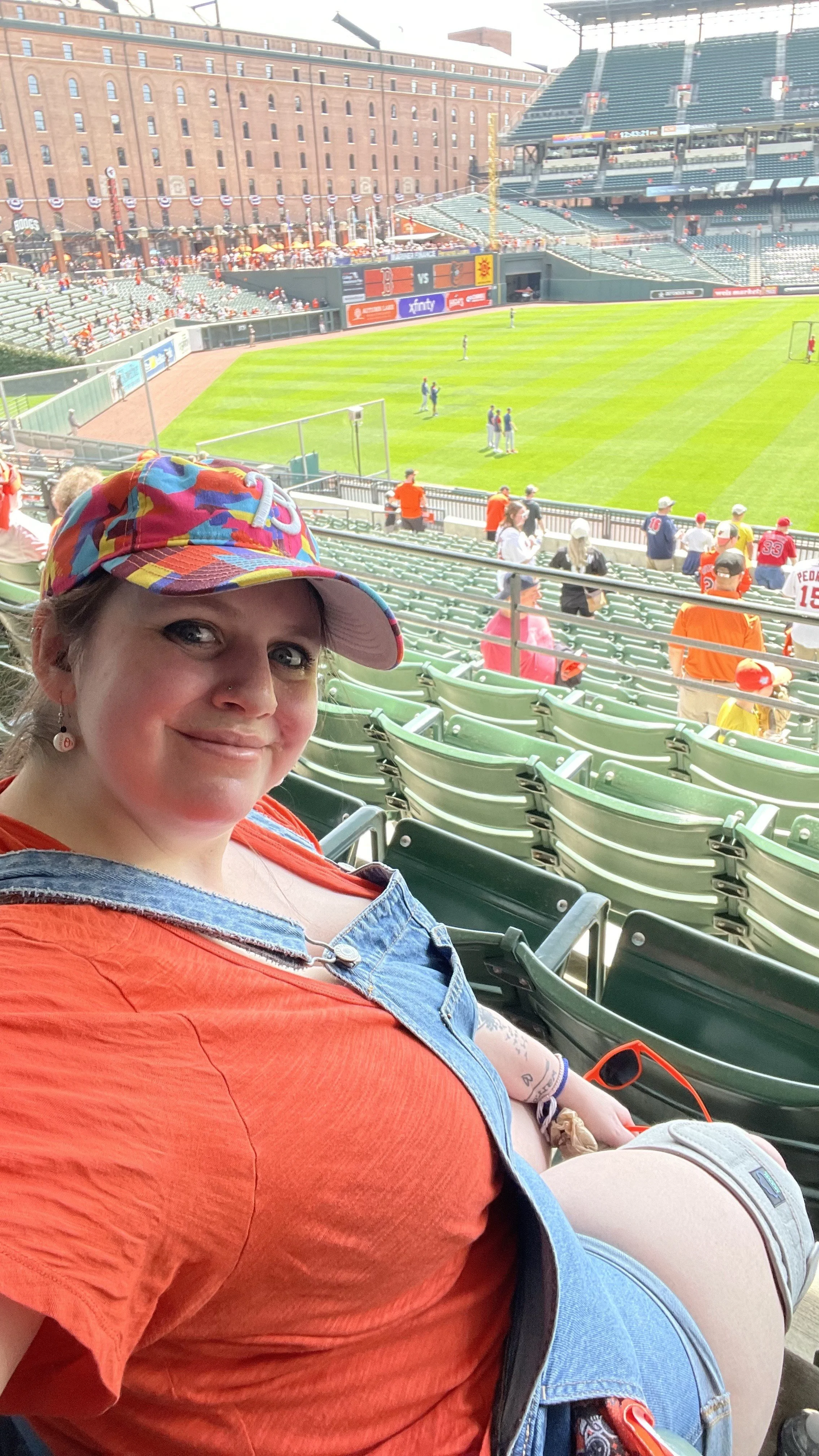
Courtesy of Liz Thompson
What makes a good scorecard design?
You just need space to be able to score. You can score however works for you. The one that I've just started working with is the four-quadrant design. It really is just about what style works for your scoring.
What differences do you see between the older scorecards and the newer ones?
There were dozens and dozens of scoring systems. Most of them did use blank boxes with various numbers and symbols. These four-quadrant ones were actually copyrighted by A.G. Spalding. I find it so interesting because, instead of just random numbers or drawing, you use each quadrant to work your way around the bag. Compared to some of the blank boxes I've seen, it allows for more tracking than some of the other systems.
How have you seen scoring change over time?
I have a line from a 1904 article that talks about how individual scorers will adapt their scoring and evolve their own scoring as they learn and do it, and have experience. I would say it's changed a lot from where the earliest systems that Henry Chadwick put out were very formulaic, not really something that you can decipher on sight. There's ones that I still can't entirely read. Once we move past that, I would say it's become its own language, but everybody has their own dialect.
What inspired your interest in vintage scorecards?
I'm a SABR member, and so when I decided to present at the Women's Conference, I was like, "Okay, I got to have some sort of research here." I just started being fascinated just by how many there were. The fact that there's one AG Spalding vintage design, you just don't really see it these days anymore. I was very interested in trying to figure out a system for that one.
My research, going back to the early 1900s, talks about the best way to learn baseball is by keeping score. One of the phrases it used was, "They will find themselves enjoying it more than they ever thought possible if they learned how to score a game."
I think for me, it's become my new mission, because not a lot of ballparks are selling scorecards anymore. They don't sell them at Camden Yards anymore, it breaks my heart because I get comments all the time with my book about, "Oh, I haven't done that in forever. I didn't know you could do that." I get that from younger people. I'm like, "Okay, I want to change this."
When I go to Philly, the guy’s right there when you walk in the gate selling scorecards and programs. It's a good value too. The Orioles technically have a scorecard available, but you have to know where to ask, and it's not worth the price.
For me, I just wanted a scorebook that worked for me, and then other people wanted it. Now I want to get people scoring baseball games again to help grow the game in my own way.
Do you score in pen or pencil?
I use erasable pen.
What has surprised you the most about your research?
Just how so many people try to outdo each other. You have people who are like, "Here's the best system to use." Henry Chadwick, the father of baseball, basically gave us a lot of the rules that started the game in the 1840s to '60s. His system, even in his rule books, he was like, “The only scorebook that would work is mine.” Spalding had his. All of them were like, "My system is simple. My system is going to be the best." I find that hilarious because they're all saying I have a simple system, and then none of them are simple.
I get that. I was at Citi Field and I didn’t have my scorebook with me. I wanted to buy one, but you could only get one in the program, which cost like $10.
At Philly, the program that you can get with the scorecard is $3. You can get full rosters. Sometimes there's a story or two. For me, that's the idea. Not necessarily just the scorecard, but getting all of it. We have the technology, why not?
To learn more about Thompson’s work, check out her website and follow her on bluesky.
