How the Dodgers broadcasting team prepared for Shohei Ohtani’s 50-50 game
MLB
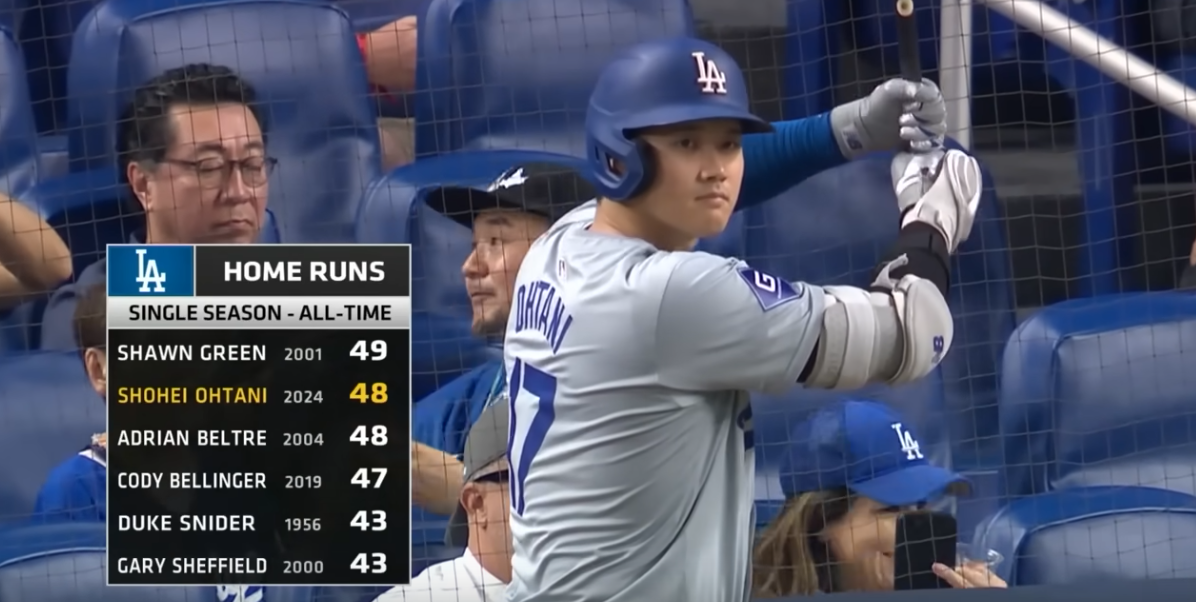
Last Thursday, the Los Angeles Dodgers broadcasting team appeared on a Televerse panel in Downtown Los Angeles to talk about what it takes to prepare coverage for an historic moment. Hosted by Sportsnet anchor Josh Hartung and featuring announcer Joe Davis, correspondent Kirsten Watson, analyst Nomar Garciaparra, executive producer Mike Levy, director Ben Dillenberger, and producer Stu Mitchell, the panel tracked each team member’s approach to handling Shohei Ohtani’s history-making 50-50 game last September against the Marlins – which also happened to break Shawn Green’s franchise record for home runs (49) and also happened to be one of the best single game performances in the history of baseball and also the day the Dodgers clinched their playoff spot.
How to wrangle multiple storylines during an historic game
While it may now seem inevitable that Shohei Ohtani would hit the milestone of fifty stolen bases and fifty home runs in the 2024 season, during the season itself, at times it felt like a reach. In fact, up to the day that Ohtani accomplished his goal, the Dodgers preshows ended with a graphic that asked whether or not Ohtani would make it to 50-50. According to Stu Mitchell, it wasn’t until September 19, 2024, the actual day that Ohtani accomplished the feat, that the Dodgers broadcasting team decided to end the preshow with a more confident graphic about whether this was the day Ohtani would make it.
While the 50-50 milestone is, in hindsight, the biggest story of the game, only a small percentage of the preshow was dedicated to Ohtani, with most of the program focused on the post season spot as well as Jack Flaherty’s recent performance. A big part of this decision was that, in the time leading up to the game, the broadcasting team simply did not think that Ohtani would achieve 50-50 on that day. He was currently at 49 stolen bases and 48 home runs, and Ohtani had not stolen a base and hit two home runs in a single game that season. According to Mike Levy, “The odds of him doing both in one game felt slim… but clearly we were ready for any possible scenario.” (Josh Hartung, who had the day off, was rooting for Ohtani to wait a game, so he could be there).
Capturing the stolen base
While the broadcast team was fairly certain Ohtani would not hit 50-50 during this particular game, they were ready for it with graphics, especially for his fiftieth steal after he hit a double. Levy shared, “Anytime he’s on base, that’s the key, more so than anyone who has ever hit a double.” As for catching the base stealing on screen, Ben Dillenberger used the low home robo camera for the main shot. “I always do that if I think they’re going to steal because you can see him run, you can see him jump in that shot,” he shared, “these moments make it easy because its quality baseball, you make sure you’re prepared and then you get in that moment.”
Adding to the complications of covering the game was the fact that it took place in Miami, and not at Dodger Stadium, which meant the broadcast team had to work with a local camera crew from Miami. Because of the unique nature of the possibility of Ohtani stealing his 50th base, they also needed to prepare the crew for the break needed to take away and authenticate the base and even a possible curtain call. Curtain calls rarely happen when a team is on the road, but as Hartung pointed out, “In television, you need to be ready for everything.”
In the dugout, the team was buzzing, according to Kirsten Watson. “All the guys are kind of looking over trying to see the bag. After we had that moment, it was like, ‘He did it, now what’s next?’ What’s going to happen next in the game, because it always feels like it was something with him.”
50-50
What came next was shaping up to be one of the best single player performances ever – even without counting the milestone. When the homer in the sixth inning came, the broadcasting team began wondering if Ohtani would be pulled from the game so he could hit the milestone at Dodger Stadium. But Ohtani was allowed to bat again, and then there came another wrench (for the broadcasting team, that is) – what if Ohtani hit for the cycle?
Ohtani had now hit a single, a double, and a home run. While the broadcast team was prepped for a 50-50 achievement, they weren’t prepped for a guy hitting for the cycle. “That freaked us all out” Levi shared, “So now everybody in the truck is scrambling. ‘When was the last time anyone hit for a cycle? Do we have video of the last cycle?’ Obviously, we have stats guys, we have graphics people, everyone’s looking up stuff like crazy.” (Fun fact, apparently Teoscar Hernandez tried to convince Ohtani to hit for the cycle instead of 50-50 during the game).
While the team in the truck were scrambling to make cycle graphics, the camera was trained on Marlins manager Skip Schumaker, who was getting the recommendation from his staff to walk Ohtani. Fans will remember the viral footage that captures his response, “Fuck that, too much respect for this guy for that shit to happen.” As for capturing that moment, Dillenberger said that it was pure luck, as he had no idea what Shumaker was going to say.
After that Shumaker’s call, Ohtani’s hit made history, and the broadcasters were ready for it.
Part of the special coverage of the play meant deciding against immediate replays of the home run (fans would be able to watch those over and over again later) and staying in the present moment, following Ohtani into the dugout. According to Levi, “We just kept thinking, if we were fans at home, what would we want to see? And there’s nothing better than seeing this.” Dillenberger pointed out that after that second home run, he left some cameras continuously on Ohtani so they could cut to him throughout the rest of the game. “You’re just covering the game a bit differently.”
In response to a question from Hartung on how to handle the big moments without losing yourself, Joe Davis said of the team, “They give me practice at big moments like once a week.” He also shared some advice he got from Dodgers broadcasting legend Vin Scully. “He told me, ‘If your house is burning down, and you’re freaking out, you’re probably not going to save the cat. But if you take a deep breath, and you go in calmly - you’re going to get the cat.’ The bigger the moment, the better you have to be at slowing it down.”

Contrary to what most people might think, Davis hadn’t prepared what he wanted to say for the big moment, as he didn’t want it to feel scripted. “I’m just allowing words to come to my head, just leaning forward… Just ready to do what you’re in the chair to do.” At the end of the day, it was all about capturing the experience of the extraordinary game as well as the achievement. “This may be the single greatest game in baseball history whether he hits fifty fifty or not. It’s the greatest individual performance ever when you’re looking at the stat line.”
And that performance will stand the test of time. During the game in which Ohtani became the first MLB player every to hit 50-50, he also went six-for-six. He hit three homers and stole two bases (first in MLB history to do both in one game). He batted in ten runs.
As Garciaparra put it, “You wanted to see history made, and then it continued.”