Tracking relocation through design
Jake Berman’s subway map-esque design tracks where every MLB team has been
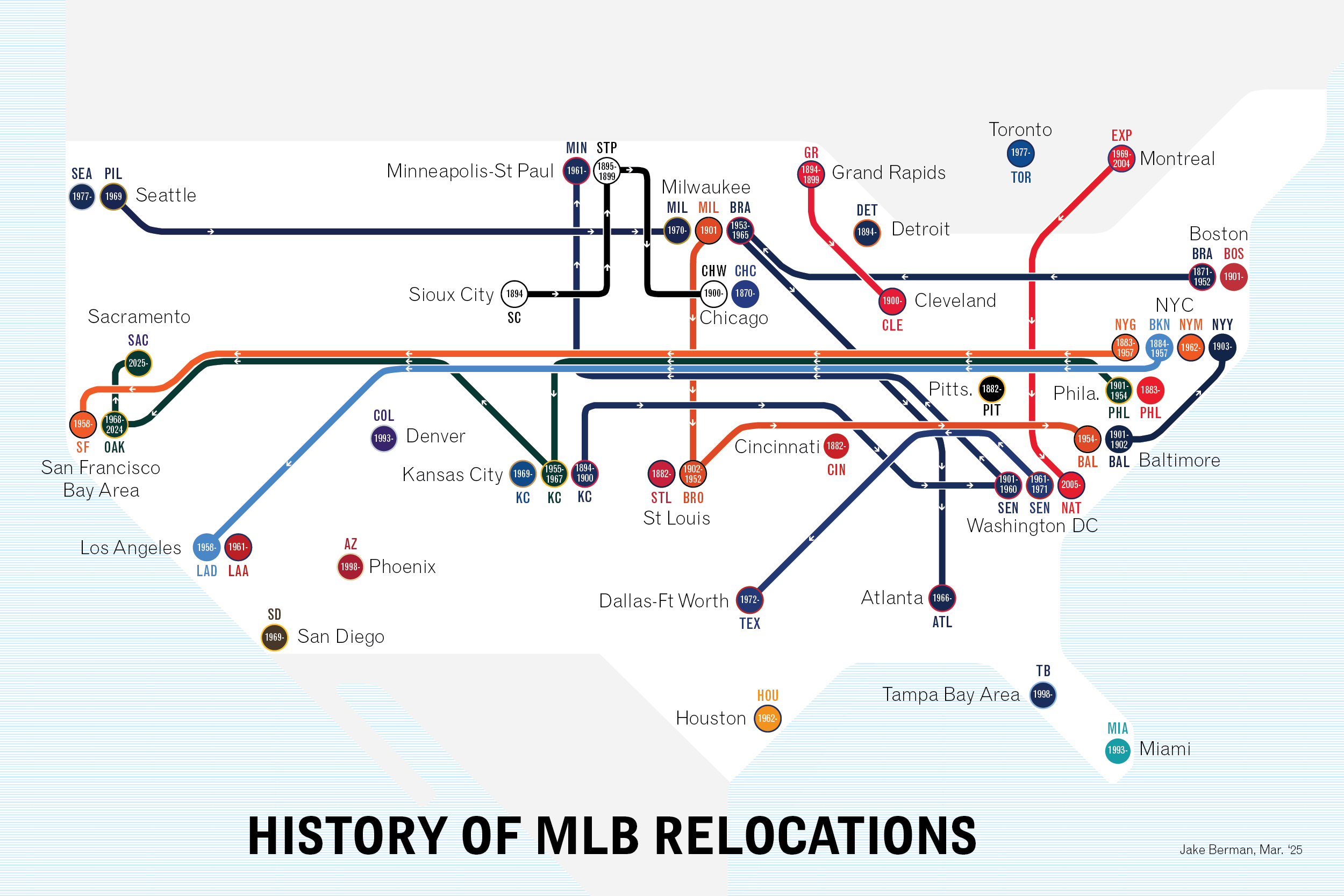
Jake Berman/53 Studio
Disclosure: This article contains affiliate links, meaning The Fan Files will receive a small commission if you choose to purchase through any of the below links.
Jake Berman is obsessed with maps. In fact, he’s even written a book titled The Lost Subways of North America: A Cartographic Guide to the Past, Present and What Might Have Been. While that book sounds fascinating (especially for anyone with interest in public transportation), what makes Berman interesting to baseball fans is an attractive diagram he’s made following all MLB relocations.
I first came across Berman’s design on Reddit and was struck by the simplicity of the diagram and its ability to communicate so much history in a single image. Interestingly enough, Berman’s personal history with maps is actually personal. In 2008, he accidentally missed a blind date because he couldn’t figure out the New York City subway map. Unlike most others who simply would call the whole thing a wash, Berman decided to make his own map of the subway system. It wasn’t long before he was obsessed with cartography.
As for the baseball aspect of the map, Berman grew up a Giants fan, watching Rick Reuschel, Will Clark, and Matt Williams at Candlestick in the late eighties and early nineties. He began this project because he was looking for a good visualization of where each franchise has moved over time. “The information is obviously out there,” he shares, “but not in a visual form that’s easily digestible.” As a trained historian, gathering the history of each MLB team came naturally. For sources, he started with Baseball Reference and Wikipedia, and then dug deeper into the history of the league.
When it came to the design of the project, Berman had to make sure that relocated teams weren’t confused with their newer replacements, and he ended up changing abbreviations when he needed to. “Most baseball media uses WSH as the abbreviation for the Nats. I chose to use NAT instead, because the old Senators could also be "WSH," says Berman. It was also tough to find enough space on certain parts of the diagram, especially due to the density of teams that play or have played in the Northeast.
Another particular challenge with this project was making the call on what to show when a team has a murkier history. “Take the Yankees, for example,” Berman shares. “Everyone agrees that the Yankees first started playing in New York in 1903 as the Highlanders. But historians disagree as to whether the Highlanders' franchise was brand-new, or whether it was a relocation of the Baltimore Orioles of 1901-2.” That Berman and other historians struggle to nail down exactly what happened in history serves as a reminder of the murkiness present in all of our history that doesn’t always show up on diagrams. And yet, the diagram is still useful.
It gives, at a glance, a quick look at the history of the franchises we all follow, who has traveled where, and who has stuck around. In other words, Berman’s History of MLB Relocations is awesome and a really cool resource for anyone with an interest in baseball history.
Copies of Jake Berman’s History of MLB Relocations are available in Berman’s webstore.