
“It’s not just a different game, it’s a worse game”
Jane Leavy on the state of baseball
Annie Wermiel/Grand Central
Disclosure: This article contains affiliate links, meaning The Fan Files will receive a small commission if you choose to purchase through any of the below links.
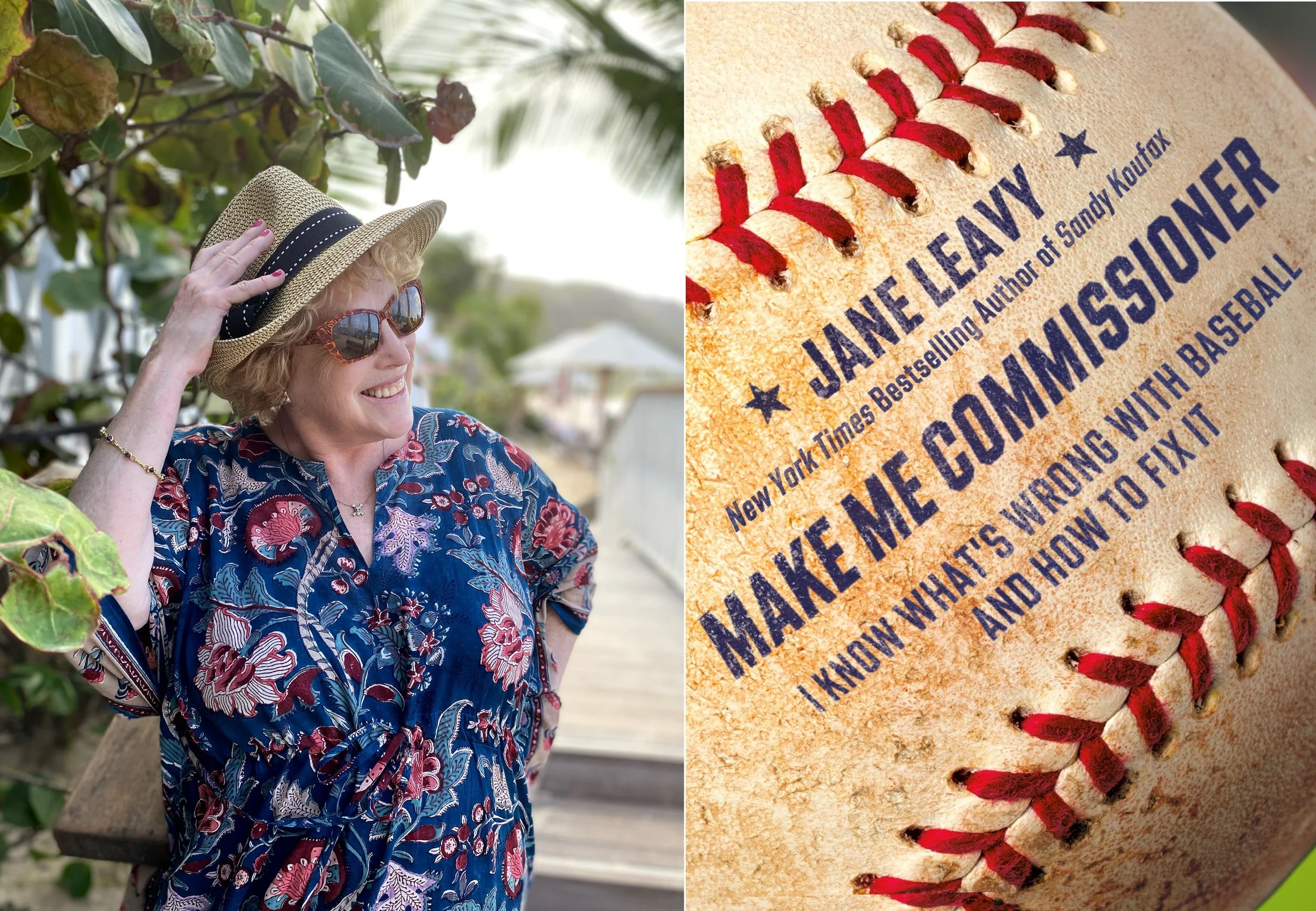
Jane Leavy’s new book Make Me the Commissioner: I know What’s Wrong with Baseball and How to Fix It touches on the core debates of contemporary baseball, from the successful showmanship of the Savannah Bananas to the impact of analytics to the proliferation of travel ball, weaving Leavy’s own perspectives with important voices from past and present baseball professionals. In the following conversation, we chat how the book came about as well as the most urgent and under-discussed issues baseball is facing today.
Where did the concept of this book come from?
I think it was when the New York Times ran an Opening Day column on the op-ed page in 2022, recommending that baseball be federalized, that I said, "There might be a problem here."
There was also that telltale breakfast with Sandy Koufax and Joe Torre at the Otesaga Hotel in Cooperstown during... I think it was 2019 induction weekend. Joe was still working in the commissioner's office, and Sandy was being Sandy. Joe said [about the current game], "Hard to watch," and Sandy said, "I don't watch."
I thought, "Okay, that is a problem. That is a real problem." That they're losing the player old-timers has been obvious for a number of years now. They feel ignored, disrespected.
There's a story in the book that Jim Palmer told me about Jim Kaat, also a Hall of Famer, going to a Twins spring training camp with two other Hall of Famers, Rod Carew and Paul Molitor, and being basically kept in quarantine because nobody wanted them talking to or giving contrary advice to their players. Kaat heard Carlos Correa, now back with the Astros, walk by and say, "What could you tell me?"
There is a definite feeling of being disrespected. “Mind your elders” is something nobody wants to hear when you're in the thrall, and it's your time and your platform, but they need to listen. They need to understand that there's more to it than people creating algorithms. Yes, the people who are making the algorithms are brilliant in a way I can't understand, much less aspire to, but they don't have what's called domain knowledge. More frightening than that, my MIT professor friend Peko Hosoi said, is they don't think it's necessary. They're just saying, "This is the formula. The formula works. Here it is, use it," as opposed to saying, "Well, maybe it doesn't work when the variables are human beings and the wind picks up, or there's a pebble on the infield."
Algorithms don't make mistakes, and they don't get tired like human beings do. How do you factor that into an equation when you're trying to predict what's going to happen?
There's the classic case that Torre talked about, which is Rajai Davis gets called upon to pinch hit in Game 7 of the 2016 World Series. He had all of twelve home runs that year. He's the last guy you want up in that place. You're not going to send him up unless you have nobody else to send. He had no business sending him up there.
An equation can't predict what's going to happen in a specific occasion. It can tell you that 9 times out of 10, this is what's going to happen, and you can rely on that, but it cannot tell you what's going to happen in a given moment. In the given moment, Rajai Davis hits a home run and ties the game.
A more recent one, the Cubs had a young guy, Ben Brown pitching a no-hitter. They take him out just because that's now the norm, but who says he couldn't have finished it? There's no recognition that the loss of those moments and those accomplishments have created a deficit. It's not just a different game, it's a worse game, in my view.
In the analytic world, [they] don't agree. They think it's just fine the way it is, and they're entitled to their point of view. I don't find it as interesting to watch a starting pitcher go five innings and get taken out, and then have them piece together the rest of the outs from tired relievers who've been overused by the end of June.
It's just an entirely different way of looking at the best way to win. What it doesn't take into consideration is, is it the best way to sell the game? Is it the best way to entertain people? Is it the best way to draw them in? I think that's where the equation, in this case, is totally fallacious.
I don't even sit up and twitch when there's a home run. They're so ubiquitous. Or, a strikeout. Some strikeouts are really worth watching. Now, it's all the time. It's deadened its soul, and it's vitiated the narrative lines that used to hold an at-bat, or a game, or a series, or a season, or even a decade together.
What issue in baseball do you think is the most urgent to address?
The elbows. Because it is morally wrong to send people out there knowing that their arms are going to break, and not really care. Figuring out some percentage of those guys will have Tommy John and will come back good as new or better. Another percentage will disappear. I think a number of 70% make it back, 59% or 60% are as good afterwards. That's a lot of people who aren't. You're not only risking the health of your players and spending a shit-ton of money on doctors and surgeons and rehabs, but you're also messing with the health of the game. Because again, how do you root for people who aren't there?
In addition to the fact that the Yankees started the season without a third baseman, which is a little stupid, they lost two of their starting pitchers Gerrit Cole and Clarke Schmidt. The Braves have been worse, and the Dodgers, worst of all. If I were Ohtani, you know what? I would say, "I'm not pitching for you guys." He's already had two Tommy Johns. I know the ego and the talent are a wicked temptress, and he wants to be able to do both. Yes, it's amazing. I think he's a better offensive player than he is a pitcher, though - he's certainly had his moments, like striking out Mike Trout in the last out of the WBC.
I'd be saying, "I don't know. Something's going on here. Look how many pitchers you've lost this year. This is bad." Again, by being willing to risk that whole composition of your team, you're taking away not just your chances of winning, which is okay, it's happening to everybody, but you're taking away from the health of the game because you're taking away people to root for. People used to go out to see Gerrit Cole. He's not going to be there for 16 months, or whatever it is. I think that's urgent.
I can't weigh it. It's very hard for me to, because it involves people being hurt.
Finding a way to re-establish balance between offense and pitching and hitting seems essential, and growing a newer, younger audience is essential. The old people that have been sustaining the game, as my friend Mike Halpert, the economist who helped me out so much, said, we're dying. We're gone. Who's going to pass the game down? Who's going to say, "Look at what's going on out there?" It's not just a swing and a miss. They don't know what to look for because no one points it out. No one values it.
Speaking of young people, you have this chapter in your book where you and Peko Hosoi make a phone game for the kids, where they’re guessing what the next at bat’s outcome will be. I loved the idea in a way, but is that really the way to get to younger fans?
Well, yes. Human beings have this silly idea that it's a good idea to replace themselves with machinery and technology. That's a costly trade-off in some ways, and it certainly has been in baseball. It's not going to stop. People aren't going to stop spending 24 hours a day with screens of one kind or another. Rather than stick your head in the sand and say, "No, we're not going to do it. We're going to cut off all the Wi-Fi so nobody can check anything while they're at the ballpark" - That would be the opposite way to go, and equally stupid, find a way to use the technology to help instruct and entice kids.
Peko Hosoi is a professor of engineering and mathematics and God knows what else, and the creator of the MIT Sports Analytics Lab. I cold-called her one day and said, "You fucked baseball. Don't you think you should fix it?" She was good enough to laugh and not hang up, and so I issued her a challenge. I said, "Could you build an algorithm at the analytics lab, something that would be transportable to the baseball field that we could test to see, A, if it works, and B, if it's enticing?"
In fact, there were about five students involved, maybe six. I don't know how big exactly the team was, but not big. As part of their summer requirements, they created a game called “Beat the Bot.” It was pretty simplistic in terms of you're trying to out-guess the bot about what's the outcome going to be of the next pitch. It certainly was meant to be just for a trial run. "It could be easily," she said, "gussied up to be more complicated. You could have an adult version, all sorts of options.”
The fact was that as soon as we announced it - we announced it at the last minute at this Cape League baseball game and there was some posters put up - we got 80 volunteers. All these little kids were running around saying, "Mom, I need your phone. I need your phone. I got to beat the bot." 80 people played, which is amazing. Kids were running up to them and saying, "Oh, is it okay if my password is froggypants?" Peko goes, "Yes, that's fine."
Another kid said, "Can we play now?" It was the second inning. She said, "No, we're not going to play until the fifth inning. Do you know what innings are? Look at the scoreboard out there. Do you see where that two is?" She did a mini instruction on how to understand the numbers on the scoreboard. The kid was thrilled, and he played.
Then there were the kids who, usually agitating to leave, who weren't agitating to leave, and who, in fact, insisted upon staying longer than their parents had intended or wanted. I'd be very happy to sell it to Major League Baseball for a shit-ton of money. The point was to illustrate that there are things that can be done to entice younger kids and speak to them.
If you could choose one person beyond yourself who has the best vision for the future of baseball, who would it be?
I don't want to pick somebody old. The thrust is that the game should be tailored to old people. It should find ways to accommodate that which old people know and enjoy about it, and at the same time drawing in a newer, younger audience. I'm going to say something. Theo [Epstein], probably. Theo will probably be the next commissioner. He liked my idea about letting kids 10 and under in.
Alex Bregman would be a good commissioner when he's done playing. I think he's thinking about managing already, much to his wife's consternation.
How many interviews did you conduct for the book?
I haven't counted.
It seems like a lot. You spoke to a lot of people.
I'm a notorious over-reporter. I guess I should go through and count them sometime. Unless you want to do it, feel free. I got, of course, people I left out that were incidental, people in the crowd, or this or that, or people I didn't use at all. I'll count it and let you know.
How did you organize the layout of the book? Did you know exactly what topics you were going to speak to when you started out, or did that arise out of the interviews?
No, because when I started, it was before the new rules were announced, much less imposed. I was going down one track, thinking the game was going to continue to be played with the shift and with the interminable delays between balls put in play. I read something in the book two nights ago, and I said, "That can't be right. Three minutes and somewhat seconds between balls in play in 2021? Is that really right?"
Then, as soon as the rules were announced in, I think, September 2022, by then everybody knew what was coming. Nonetheless, as soon as they were announced, I realized, just because of the mechanics of publishing and the time involved in writing and then getting a book in shape to publish, there was no way I could write about the time period preceding the new rules and leading up to them. I was going to have to get rid of all the interviews and the material and the writing that I had done prior to '23.
It started in January '23, basically going anywhere where baseball was being played, taught, improvised, in every level I could find, so that I was seeing it all and seeing how it responded to the new rules and how it didn't if people weren't using them, and seeing what worked. I think it was very obvious and very fast after just, I think it was 95 spring training games that the pitch clock was going to work. Yes, at the beginning, there were pitch clock violations, but not that many of them, honestly. You still get one or two now, but it doesn't happen very much. People accommodated to it. People really can change.
It was unfortunate that it had to be legislated, but sometimes good government requires legislation. That obviously worked. I think different people have different feelings about the three-batter rule, about how many times the pitcher can throw over, about the size of the new bags. The old-timers hate it because they think it's lazy, because they should have learned the right way to steal a base and to save themselves inches in time by learning how to cut the bag right.
They made a good start. The pitch clock was absolutely necessary. There's so much more to do. That's what's become obvious to me.
One last question. You touch on the hot topics that everyone's been talking about lately in your book. Are there any major problems you think people aren't talking about?
I'm not sure they're completely not talking about it, but the classic tête-à-tête in labor. The fans hate this stuff. I covered strikes. It's not what people want to read in the sports section or online or wherever. When Manfred came out and announced that there was going to be a lockout on December 2nd, 2026, and he announced it at just about the opening of spring training 2025, I said to myself, "What is he thinking? How do you entice people to come to a game and say, 'Get involved in the sport,' and then say, 'But hey, we're going to have this thing, and it's not so bad because it's more like using a .22, than a nuclear weapon.'"
How many times does baseball have to shoot itself in the foot? I think to the extent that they've won people back with some of the improvements they've made, it would be insane to do that dance again.
