
Painting Baseball History
How Graig Kreindler recreates iconic baseball scenes on canvas
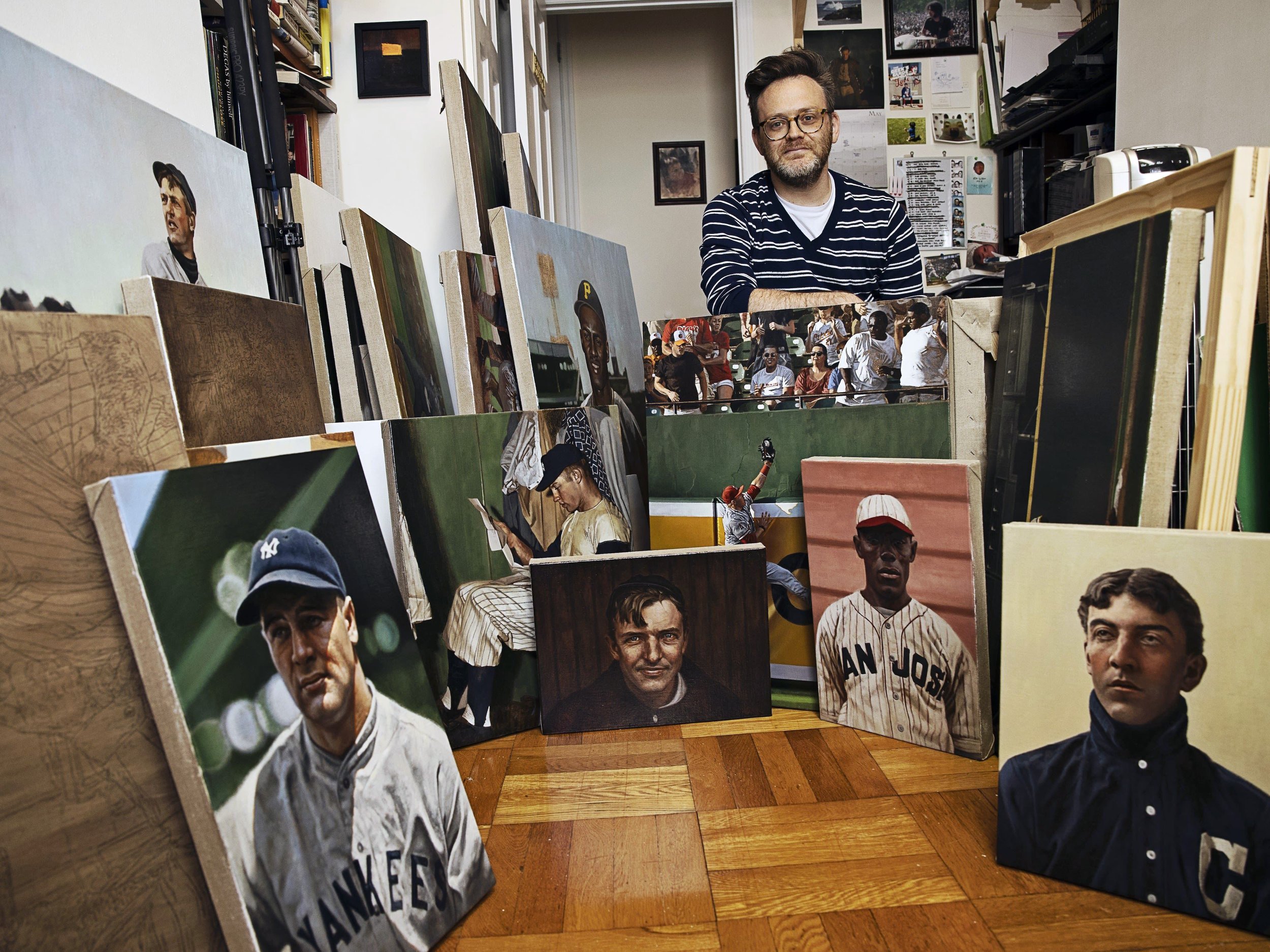
Photo Credit: Kimberly M. Wang
Graig Kreindler is focused on getting the details right, so much so that he calls himself a visual historian. “I think my saying that I'm a visual historian is my attempt to hold myself accountable for making sure everything is historically accurate as possible,” Kreindler explains, "When I'm painting things, they have to be historically accurate. Does this look like Mickey Mantle? Did he have hazel-colored eyes? Did so-and-so hit a home run on this day? What was the weather like that day?"
When I first came across Kreindler’s work on Facebook, I was struck by the classic illustration feel to his work, as well as the omnipresent sense of baseball history on each panel. That sense of history is earned through copious amounts of research, down to the color of the advertisements in the outfield on any given day. “If you talk about this sort of stuff with any normal human being, their eyes roll into the back of their heads," he says. "To the baseball community, or at least some of the baseball community, that stuff becomes important.”
But it’s most important to Kreindler himself, who doesn't even consider his work done once the painting is varnished and sold. Sometimes, years later, he’ll find that he had painted an error into an assignment handed off long ago. When he finds that one of his paintings has something “wrong” in it, he will call the painting’s owner and ask for it back to make the correction. (Kreindler, of course, pays for shipping both ways.) The first few times were a bit of a shock to the paintings' owners. Now, Kreindler is known for it.
Usually, the painting’s owner happily agrees to Kreindler's request. But sometimes, every once in a while (once out of every twenty, Kreindler guesses), an owner says no. “That just breaks my heart,” says Kreindler . At that point, he is saddled with the error (that most likely no one will ever notice), and it haunts him. “It's like I failed. In my mind, I failed at my job and there's nothing I can do about it."
As artists and their subjects go, Graig Kreindler came by his honestly. He was named after Yankees third baseman Graig Nettles. Kreindler father grew up in New York City in the late forties and early fifties. His mother was a Brooklyn Dodgers fan. With that pedigree and that name, “It almost guaranteed that I was going to have baseball in my life somehow,” Kreindler says. When he was a kid, he hoped that would mean playing in the major leagues. But his lack of coordination put that dream to bed.
Though young Kreindler adored the Yankees of the ‘80s, they weren’t quite a World Championship team, so his father would regale him with tales of the winning Yankee teams of his own childhood. “I'm not sure why, but for whatever reason, maybe it was his baseball card collection, or maybe it was just how vivid the story seemed. I just was always really attracted to the history of the game,” he recalls.
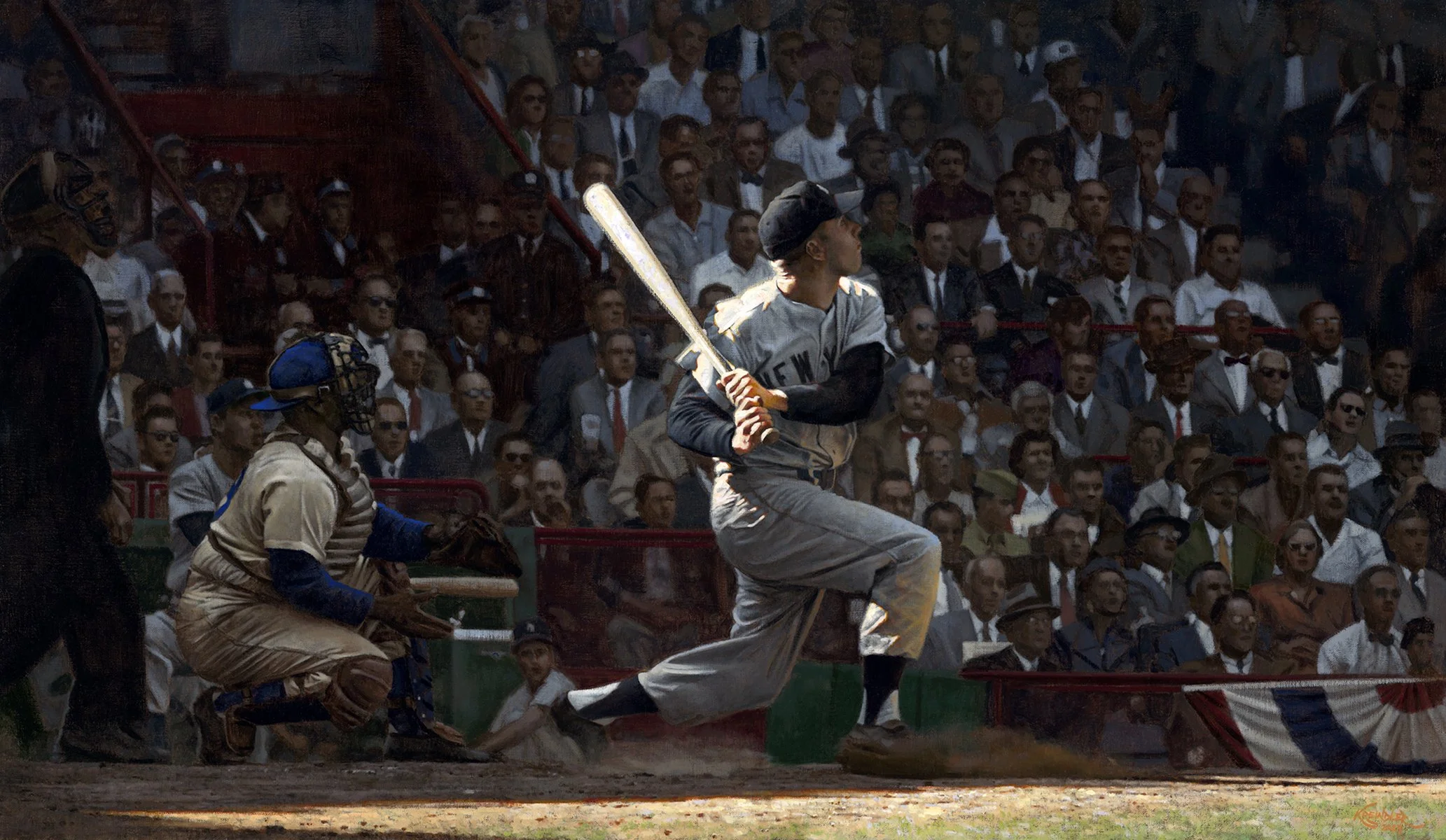
“The Big Blow” by Graig Kreindler
Kreindler’s history with baseball art stretches back to his childhood, too. As an ‘80s kid, he loved drawing characters from cartoons like He-Man, G.I. Joe, and ThunderCats, but then he discovered the remains of his father’s baseball card collection. The cards that sparked his interest were illustrated ones from the late ‘40s and ‘50s. “I think that something clicked in my head that it was something that I could do," he explains. "Not as a job when I grew up or anything, but I could draw a picture of Mickey Mantle, or try to at least. My dad would pat me on the head and say, 'Good job, son.'"
So Kreindler would draw Mickey Mantle for a while. But as he had pivoted from cartoons to baseball, he would then pivot from baseball to comic books. (Groundbreaking comics artist Jim Lee was a big inspiration to Kreindler, as well as influential comic book writer Scott Snyder, who happens to be Kreindler’s cousin.) It wasn’t until Kreindler’s time at New York’s School of Visual Arts that he returned to baseball as a subject for his art.
Kreindler had studied at SVA with the intent of working as a science fiction/fantasy book cover illustrator, but the work wasn’t quite clicking the way it should have. “I floundered a bit," Kreindler says. "I'm sitting there, as a senior, not really knowing what the heck I'm going to do when I graduate.” Then, in his portfolio class, he was given a prompt to illustrate a relationship, and the relationship that came to mind was the one between a pitcher and a batter.
Some of his inspiration was drawn from his childhood, but the project stuck with him. “I really fell in love with the process. I just had a new direction.”
Now, Kreindler has a years-long waiting list for his commissions. Each commissioned painting process begins with a brief, which is sometimes as broad as an era or a time period. Other times, it’ll be a moment or image. Usually, it is a specific player (most often, one of the Yankees’ big four: Mickey Mantle, Babe Ruth, Lou Gehrig, and Joe DiMaggio), and it is up to Kreindler to find the image or moment.
While Kreindler loves painting Ruth and Gehrig, he has done a lot of it over his career. “I wouldn't necessarily be upset if I never painted them again, because I've painted a lot of them,” he shares. He has attempted to shake things up by offering to add a weird spin onto the standard commissions — for example, painting Babe Ruth with the Boston Braves (which no one really wants), but he usually finds variety in the aesthetic, looking for an image that appeals to him on an artistic level.
As for the actual painting process, Kreindler begins every piece with an image in mind, often from a stock photo house like Getty or AP. He licenses the image, but because most of his subjects' photographs are in black and white, his job isn’t over yet. Some of his research means digging into home video, which was surprisingly available in color at the time. “A lot of that stuff certainly has disappeared over the years, but also a lot of it has been pulled together by archivists. In addition to seeing those players in color, you also get to see a lot of those ballparks in color. Stuff like that is incredibly helpful for me.” He gives a lot of credit to the creators of the HBO series When it Was a Game for helping with footage from their archives.
Kreindler doesn't only rely on images though — he also looks to the newspapers. “Sometimes you'd have a newspaper writer who would just have a throwaway comment like, 'Ted Williams hit this home run that hit off of the red and white botany sign in Brightfield,'” That sort of detail is perfect confirmation for Kreindler, as he attempts to gather as much information about the image that he can before he begins to paint – though it is typical for him to begin without having all the details in place.
Kreindler works on several paintings at once, so he is able to rotate between them as he researches. From week to week, he’s got around three or four paintings going on at a time. Sometimes, if he has to, he’ll stick to one.
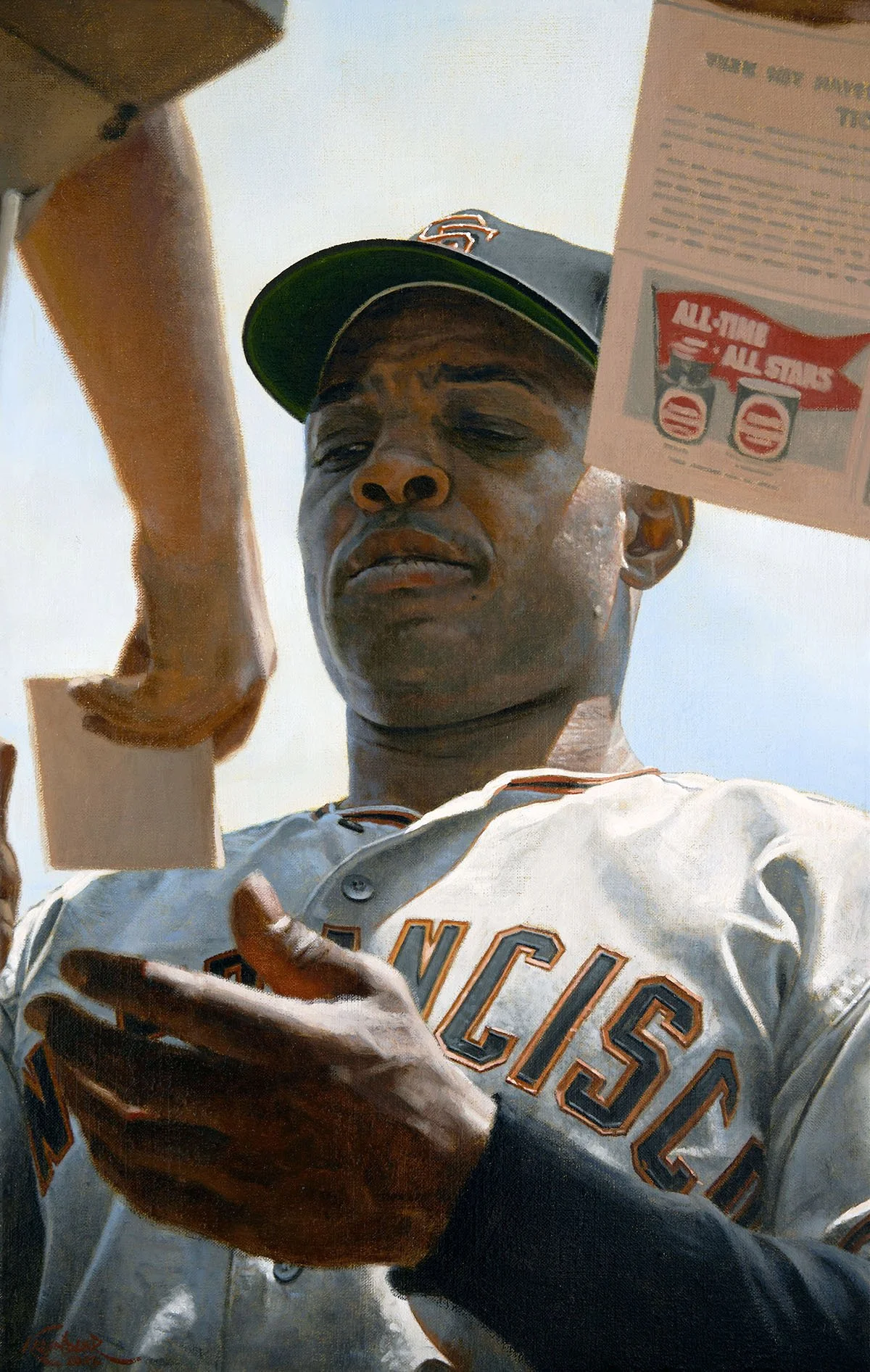
“Mays Plus Sun Equals 140,000” by Graig Kreindler
As for how much time it takes to research each painting, it depends on the complexity of the work. If the commission is just a portrait with a plain background, things tend to go pretty smoothly. But when it comes to the larger, more panoramic pieces, it can take Kreindler 10 to 20 hours of research, he says. However, having years of experience helps move the research along, especially when it comes to the settings he paints more regularly.
One of the tougher projects Kreindler has taken on is a series of portraits of Negro Leagues Players organized by historian Jay Caldwell to celebrate the Negro Leagues Baseball Museum’s Negro Leagues centennial. “That was one of the most challenging projects I've ever been a part of, without a doubt, also one of the most fun," Kreindler shares. There were far fewer visual and written sources on many of these players, which made it tough for Kreindler’s rigorous research process. There was less newspaper coverage and fewer photographs. There was also scarce physical memorabilia, but that just meant that what was left was even more valuable. Kreindler leaned heavily on collectors of Negro Leagues baseball cards and memorabilia. “[Collectors] are very, very helpful to me in general, but when it came to the Negro League stuff, they were absolutely crucial. Without them, it wouldn't have been possible at all.”
Speaking to the process of putting the Negro Leagues portraits together with even less information that usual, Kreindler said, “It was twice as hard to do the research to try to get that stuff correct and twice as likely that I might have made a mistake somewhere. Even though there aren't really many people on this earth who are alive, who saw some of those games in the '30s and '40s, it's still really important for me to get it right.”
For one player, George Stovey (an extremely skilled pitcher from the 19th century), Kreindler couldn’t find any images at all. After the project ended, he did find a photo of Kreindler as an old man, but no photos of him in his playing years. “The 19th century players in general, even in the White Leagues, are tough to find quality images to work from. With Stovey, I couldn't find a single thing. He was considered in his time, maybe the best Black pitcher in whatever independent leagues they had going on back then. Still, it's like the guy's face remains a mystery.”
Though Kreindler was told that he could paint an image of what Stovey might have looked like, he just couldn’t take on the portrait without having actual details to draw from. “I just knew that it wouldn't be right,” he says. Kreindler’s concern was that some future viewer of the painting might think that Kreindler’s imagined version was what Stover really looked like. For a visual historian so obsessed with historical detail that he changes paintings years after they're done, an imagined portrait of a real player would seem like a lie. “It would break my heart if they thought that George Stovey was looking a particular way that I had invented.”
Learn more about Graig Kreindler’s work on his website.
Graig also runs a very active Facebook page (which is where I found his work!)
