Sporting Statues
An interview about baseball statuary with statistician Dr. Chris Stride
Dr. Chris Stride is a statistician at the University of Sheffield - he’s also a fan of sports (though he would call it “sport”). Over the past decade and a half, Stride has been running a database of baseball, cricket, and football statues in the UK, the US, and worldwide. This database has helped him write academic papers about baseball statuary, including articles on what happens to baseball statues when ballparks relocate, the representation of baseball fans in sculpture, and how project ownership influences the design of baseball sculpture.
In the following conversation, we chat about the beginnings of this database, interesting trends that have popped up over the years, and what kinds of players get statues made of them and what kinds are overlooked.
What led you starting your Sports Statues Database?
A colleague of mine, who's a football fan (that's “soccer” in your terms) said, "Oh, I've been to a few matches recently and seen a few statues at Crowns. Do you know anything about them?" I didn't really know a lot, but as a statistician, my first thought was how many there are. I started looking into them and suddenly realized this was a really interesting project. I started researching sports statues in the UK and built up a database of them.
Then, whilst I was doing that, I realized that actually the US had been there a little bit before us in terms of statues of baseball players. That seemed an obvious second database to do. I then started building a database of sports statues of baseball players in the US, partly because it was a quite interesting project to do. When people write in sports history journals, they tend to write about a single case study. When you write about a single case study, it tends to be that it's one remarkable, really unusual one, but without any context, it's difficult to say why it's unusual.
I wanted to be able to write about particular statues and actually be able to say, "This is unusual because the rest of them are like this," and there wasn't any record of the rest of them. Obviously, whilst collecting the data, I thought having some public-facing database would be interesting as well. I had all the information to do it, so I put them up on a website.
That feels like a very statistician approach. You mentioned you were interested in about the number of statues. What other data points were you locking on at that point?
There were different things I was interested in. Obviously, how many are there? When was the first one? What shape of increase was there? Was it a gradual up, or was it a case that suddenly they got really popular and went up? I was interested in the sort of people who were chosen and how that corresponded to when they finished their career and indeed when their career was. Was it old players from a long way back or ones that were more recent?
Actually, what I suspected was true. It tended to be a lot of the statues were erected for nostalgia rather than history reasons. You tend to find both in the UK and in the US with sports statues, a lot of them are put up about 10, 15 years after the player's career's finished, maybe 20 years. That's because of what's called the “reminiscence bump,” when spectators think about players of their childhood. Let's say a spectator is 15 and they've got heroes about 25, 30. That player retires maybe when that person is 20-odd. When they get to 40, they start thinking back to their childhood. People in their 40s tend to think back 20 years earlier, and their heroes tend to be from that period.
It's natural that you would tend to get statues erected of players who played 20 years before the statue was put up. History has sped up; nostalgia's sped up a bit. Maybe those gaps aren't so big these days, but you get very few real old-timers have statues put up. Very few baseball players of the 1880s, 1890s, 1900s, even through to the 1920s. It's only the really famous, like Babe Ruth or Christy Mathewson. Someone like that. You don't tend to get so many of those.
Is that different from football statues?
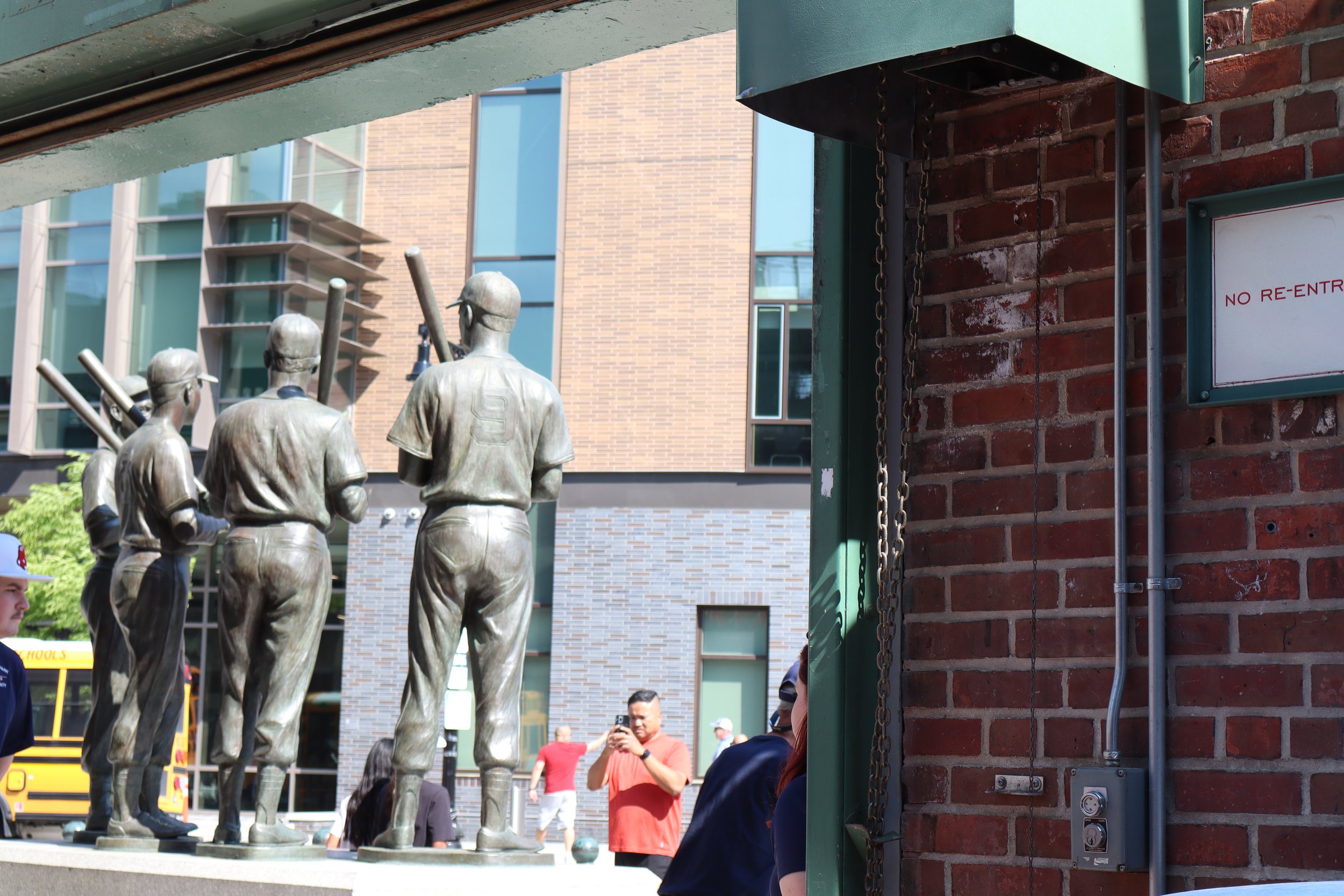
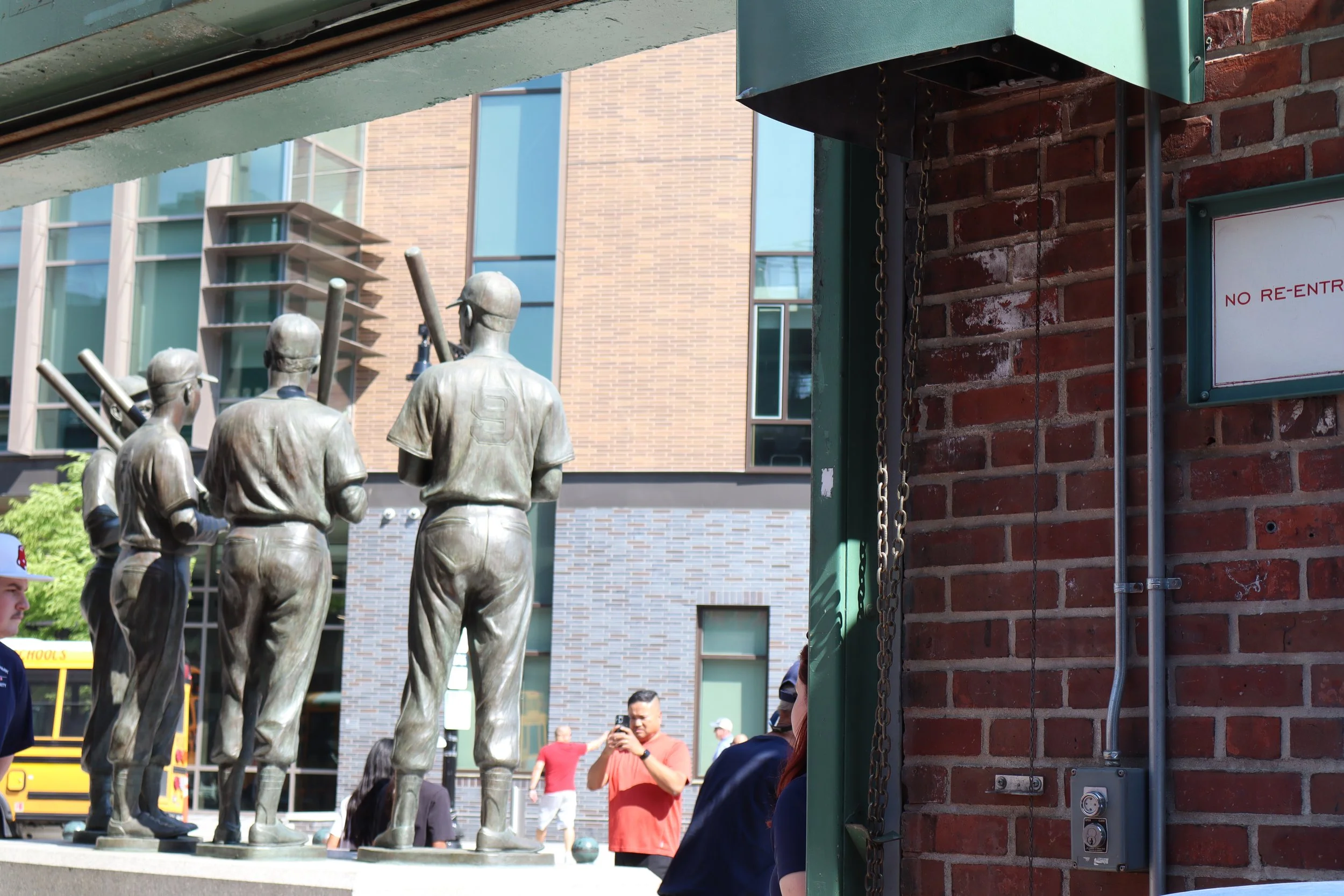
It's very similar. You do get a few, but I think just looking down my list here of people who you'd classify as real old-timers in statues that are unveiled. 95% of the baseball statues were unveiled since 1990. It's about 400 odd now, and it's 100 odd, and 95% of them in the last 30 years. The ones prior to that are just almost occasional. There's no pattern to their inauguration or sculpting. Just having a look down and trying to think of any real old-timers. I mean, Cy Young at Northeastern University, 1993. There's a couple of Babe Ruths, obviously.
There must be Joe DiMaggio.
Yes, there's DiMaggio. There's Jimmy Foxx as well, Bob Gibson. It depends how old is old. I'm saying Mickey Mantle, but Mickey Mantle was post-war, wasn't he? I'm talking people pre-World War II and around World War I. There are actually very few. Ty Cobb, Christy Mathewson.
Shoeless Joe Jackson?
Yes, there is a Shoeless Joe Jackson in Green-something, North Carolina. My American geography isn't good.
How to you keep up to date? News alerts?
The website's actually slightly out of date. I've got a year and a half's worth to put up, which is going to go up in the next few weeks. The website's only up to the end at the start of 2024 because this isn't my main job. It's an academic side hustle. The way I stay up-to-date is just largely searching on the internet. Sometimes sculptors tip me off.
I've done a few interviews with sculptors over the years, and there's a few of them who do them regularly and get in touch and say, "I'm doing this one," or, "This is about to be unveiled."
Generally, just searching. Baseball statues in the US are easy to search because it's English language. If a franchise or a college or even a hometown is putting a statue up of a hero, they'll get it in the local newspaper, or it'll be on the franchise's website or the college's website. This stuff always pops up. The anonymous ones are perhaps slightly harder to search.
That's where I was wondering, is there one out there somewhere in a town, just an anonymous baseball player who I haven't managed to find? I did a lot of heavy lifting in the early days with sculptors asking if they’ve done any anonymous ones. Also, searching art museums as well to see if there was any lying around in their archives.
You mentioned the nostalgia trend. Have you noticed any other trends?
I wrote quite a lot about this, but the idea of statues as reparations, the unveiling of statues of Negro League players from the past, and also particularly Jackie Robinson and early Black players in MLB, that's definitely a thing that's come in the last fifteen years or so. Every town likes to show that it was a town that welcomed Jackie Robinson. There's about seven or eight Jackie Robinson statues out there. The Dodgers were about the last people to do one. It tended to be towns where he'd played either a minor league or where he lived or something.
It was like, "We welcomed Jackie Robinson when the rest of the world was racist, we were nice" type stuff. There's a lot of that going on. Also, there's other Negro League players who are celebrated and the Negro League Museum as well. Yes, there was certainly a thing. I think Pittsburgh Pirates put up a whole load of Negro League statues of players who played in Pittsburgh-based Negro League teams. They put a load of them around PNC Park at one point as well. The idea of reparations through statues is definitely a thing.
Another trend— this has died down a little bit now, but there was a trend about five to ten years ago for more artistic designs rather than the plain statue of a player, a realist design. A sculpture studio called Amrany in Chicago, they started experimenting with these designs that would have a motion blur of bronze behind the arms. There's three of the Nationals like that. There's the statues at Comerica Park, Detroit, like that as well. There's a slight motion blur in some of those.
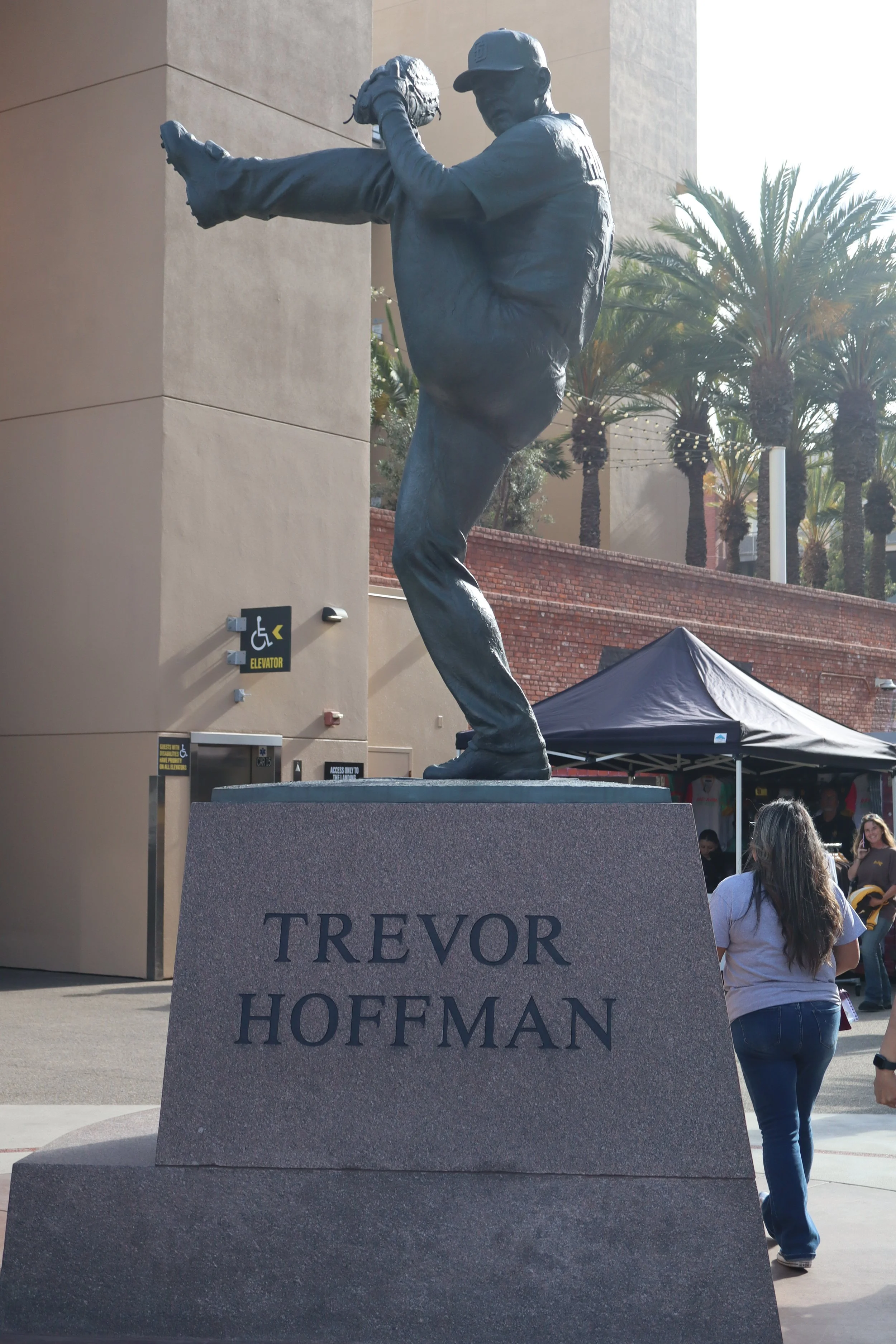
They're not quite as extreme as the ones that the Nationals have got like a guy swinging, and it's got like five bats. It's got Walter Johnson with about six arms. I think there was a brief attempt there to try and do something more interesting. Something slightly different. That hasn't really continued in the last few years, but there was a period when they tried that.
One thing that hasn't really happened has been much of an attempt to say anything about women's baseball. There's very few statues. There's one of Toni Stone, who was a female baseball player. There's an anonymous female player at the Hall of Fame Museum.
One thing about statues of baseball players is their consistency. The style is very old-fashioned. It's realist sculpture in bronze. This is very traditional way of expressing these things. You don't tend to get many abstract statues that are anything dedicated to a particular player.
Did you know a lot about statues before you started this project?
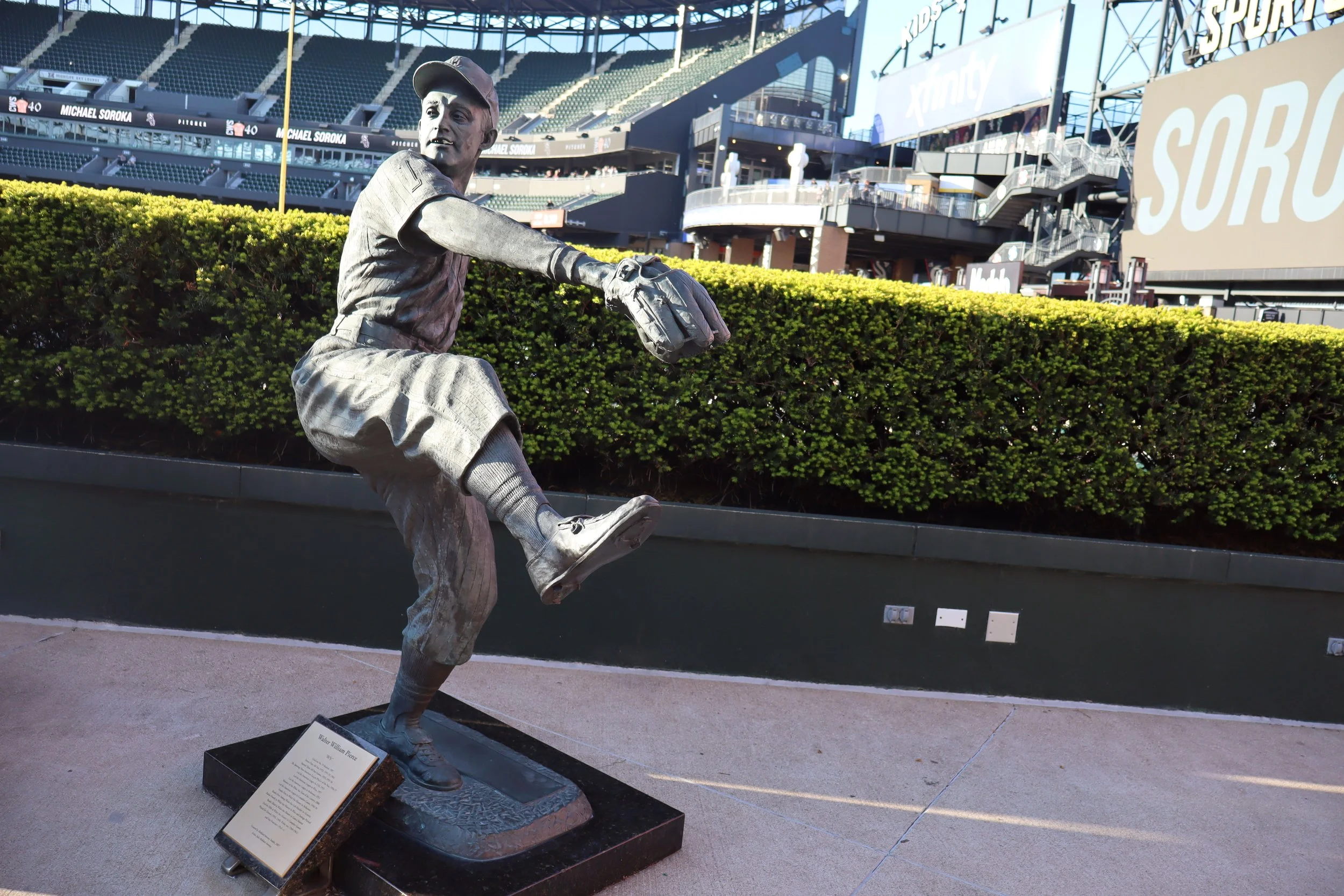
No, I didn't know a lot. I gradually acquired knowledge, about design, about issues sculptors have. Interviewing sculptors was quite interesting because actually making a statue of a sports person, you've got to try and get emotion into it, which isn't always straightforward. The baseball player, it's not like the queen. She's in a long, flowing dress. You don't have to get her legs right. In fact, you don't have to get much of her body right, but a baseball player, you have to get a lot of the body right, particularly a pitcher. The pitching action, balance, it's quite hard to capture.
The placement's important as well. You don't want to stick it right in front of a really large wall because it tends to get lost in front of a big background like that.
I think one thing that really struck me was the importance of statues to hometowns. Obviously, there's a lot of them around stadiums, but the ones that aren't around stadiums, the ones that are in cities, they tend to be in small towns. Very unlikely anybody's going to stick a statue of a baseball player in Times Square.
I'm not very good at my American geography. Whatever the most famous square is in Chicago, something like that, or LA, it's unlikely they'll put a statue of a baseball player there because there's so many other famous people from those cities. When it comes to a small town, I think if you look at the statues of Christy Mathewson or Jimmy Foxx, they're from small-town America. They're probably the most famous people ever to come out of that town. Therefore, it's an obvious thing for that town to latch onto to promote themselves and to take pride in. That's why I think the statues that aren't at stadiums or ballparks tend to be in small towns.
The one thing that really surprised me, and this is very different from the UK, and this tells you a bit about American culture, is the amount of baseball statues that are on university campuses. Obviously, college sport is a massive thing in the US, but I'd always thought college baseball was nothing like college [football]. Actually, college baseball has generated quite a few statues of players. It's quite a big thing. You would never get that in the UK. You'd never get a statue at a university of a footballer or a tennis player or something. It'd just be unheard of.
Is that because professional players usually just go into professional leagues?
Yes, absolutely. If you're a professional footballer, they'd go into the team. They wouldn't go through a college system. If it's some sort of things like Olympic sport, maybe. Loughborough University in the UK has athletic programs, but nothing like in the US. Certainly, the team sports, nowhere at all.
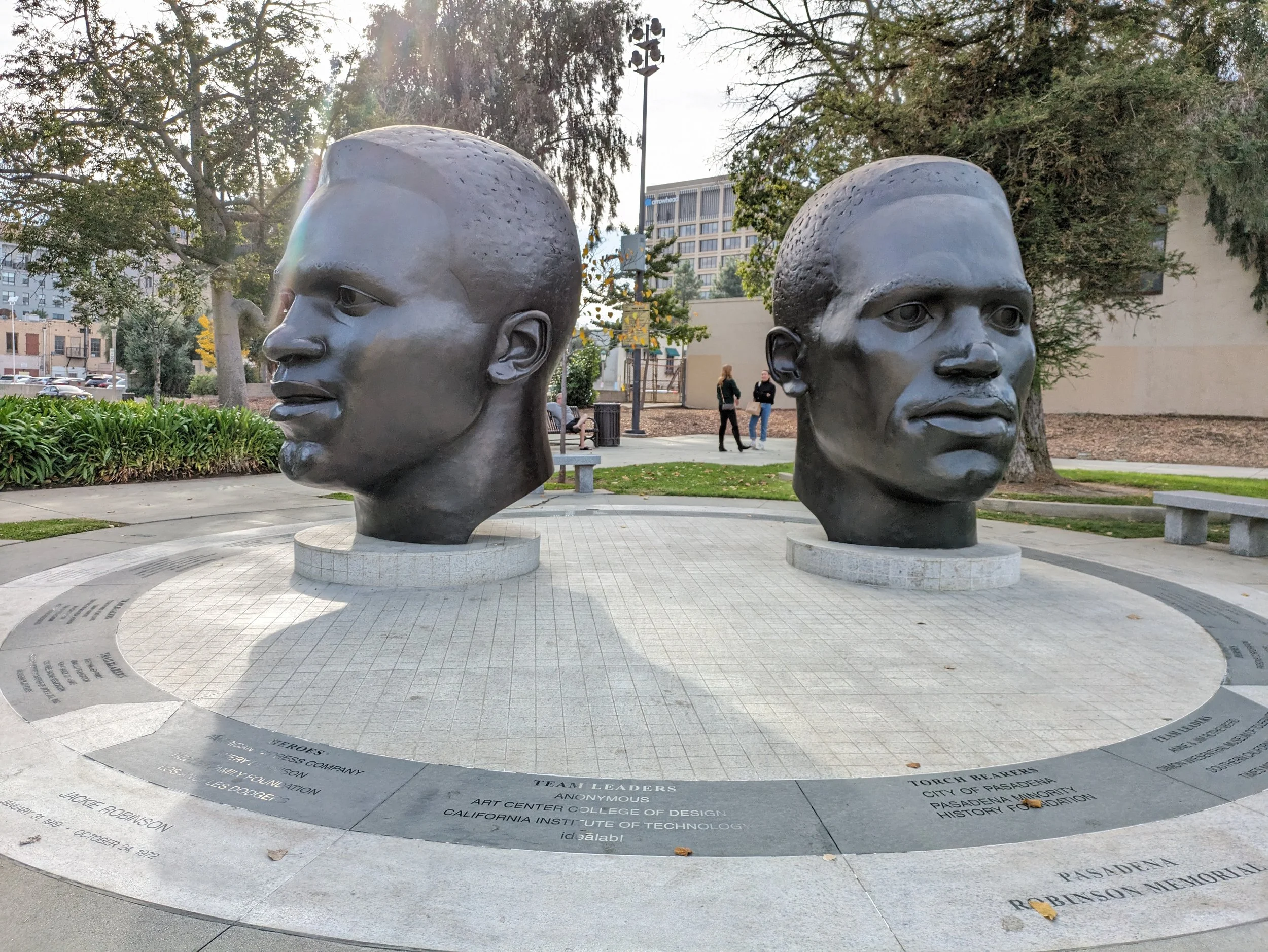
You mentioned earlier the small town thing. That piqued my interest because I'm near the town where Jackie Robinson grew up. There’s a statue, a memorial of Robinson and his brother Mack. The sculptors are insistent that this is not a baseball statue, but a memorial to the Robinsons. Do you distinguish between baseball statues and general memorials?
There's no way there would be a statue of Robinson and his brother if Robinson hadn't been a famous baseball player. I would definitely include that. Where's that?
Pasadena. It's two large busts. They have drawings designed into their hair.
It's not a full-body statue. I wouldn't include it.
So your database is all full-body statues?
Yes. If you get one that's three-quarters or something, I would include it. If it's just the head, no. That's definitely a bust. The reason I distinguish is because, actually, a lot of busts there are multiple editions of, and people collect and keep at home. What I'm interested in is public sculpture. Now, I agree that the Jackie and Mack Robinson heads are public sculpture. I do get that. There would be an argument including them in my database. I agree. There has to be some boundaries to the database, and that's why they're not there.
I would still say, the only thing about Jackie Robinson, of course, that he was a talented athlete in other ways as well. That is an interesting one because Mack Robinson got a silver medal as well. However, I still think if these were full-body statues, I would be including it, 100%. That's my database, so I can do what I want with it. The hometown stuff is really interesting. Like I said, the thing I do with the size of the town makes a big difference.
Were you into baseball before putting the database together?
Yes, very much so. I was interested in the sport and used to watch a little bit. I've been to a few games when I've been in the US.
How did you get into the sport?
I'm a cricket player in the UK, and I just remember watching a bit of baseball when I was younger on TV in the UK. We used to have a program that was late-night on Channel 4 in the UK. They said it's a bat ball sport, so playing as a cricketer, I always had a slight interest. Obviously, once I'd been and watched it live, I was interested. Then doing the database made me far more interested in the history of it because you're seeing all these names pop up as people who've had statues.
Then one of the little academic papers that I wrote was: what predicts whether you're going to get a statue if you're a Hall of Famer. Why do some Hall of Famers have them and others don't? Again, the thing about how recently they played made a difference. Loyalty to one team made a difference. There were various things that predicted whether someone got a statue or not. I looked at the people who probably should have had one, given they're in the Hall of Fame, etcetera.`
I did the same thing with football as well. There's not really an equivalent Hall of Fame in the UK, but there was a vote done a while back of the 100 greatest top division footballers. I looked at those and how many had statues and tried to predict who got one and not.
Just one last question. Have you found any particularly strange statues?
The third ever baseball statue was one of Babe Ruth, and it's missing. Nobody knows where it is. It was in an exhibition at the Rockefeller Center, and then at the Baltimore Museum of Art, and then just disappeared.
Check out Dr. Chris Stride’s database for baseball here and football here.